
TL;DR

Turn quiet afternoons into listening time
- Thousands of audiobooks, podcasts and originals
- Listen on your phone, tablet or Echo — also offline
- Cancel anytime
The NATIVE-ID project, led by the Innovative Genomics Institute at UC Berkeley, will use large-scale protein experiments and AI to study early protein dysfunction. Stowers Institute researcher Randal Halfmann’s lab is slated to receive about $4.1 million over two years to measure aggregation across 50,000 proteins; the project will initially focus on frontotemporal lobar degeneration. The approach is a research effort, not a proven method for predicting individual disease risk or preventing illness.
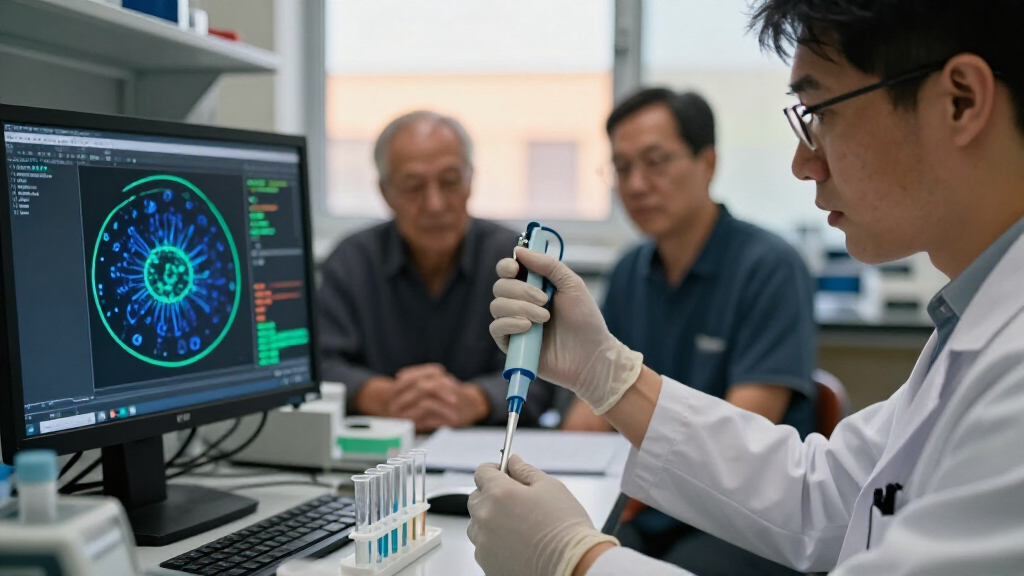
Halfmann’s team will use yeast cells to test how changes in the amino-acid sequences of proteins affect whether they remain in a normal state or form aggregates. The lab plans to examine 50,000 proteins under varied conditions intended to mimic changes associated with aging in human cells. Researchers expect to collect data across more than one million samples, producing more than 10 billion measurements, according to the source report.
The experiments will use Distributed Amphifluoric FRET (DAmFRET), a method developed by Halfmann’s team that measures protein self-assembly inside individual living cells. Halfmann said the award will allow the lab to produce experimental data at a scale not previously achieved for cellular measurements of protein aggregation. The data are intended to help train AI to identify patterns in intrinsically disordered proteins, which can take multiple shapes rather than maintaining one stable structure.
The wider project brings together researchers from UC Berkeley, Brown University, Emory University, Johns Hopkins University, Parallel Squared Technology Institute, Texas A&M University and the Stowers Institute. The team plans to begin with frontotemporal lobar degeneration (FTLD), which shares genetic and biological features with amyotrophic lateral sclerosis (ALS), while aiming to develop methods that could apply to other diseases involving protein misfolding. UC Berkeley collaborators will provide human neurons in which the team can test whether model predictions hold, according to Alejandro Sánchez Alvarado, the Stowers Institute’s president and chief scientific officer.
Building Data for Protein Prediction
The work addresses a limitation in current protein-prediction efforts. AI has advanced the prediction of many protein structures, but the source report says about one-third of proteins lack a stable structure. These intrinsically disordered proteins can shift among different shapes, making their behavior difficult to model from structure alone. Some are associated with aggregation linked to neurodegenerative disease.
If the project produces reliable predictions, researchers may gain a way to identify which protein sequences and conditions are associated with aggregation earlier in the disease process. Halfmann said better estimates of disease probability and onset age could eventually help people seek preventive or early-stage treatments or consider clinical trials. Those are potential future uses, not outcomes established by the project.
The collaboration also pairs large-scale measurements in yeast with testing in human neurons. That distinction matters: findings in one model system do not automatically show that the same patterns occur in people. The project’s planned validation work is intended to address whether predictions derived from the experimental data can hold in human cells.
As an affiliate, we earn on qualifying purchases.
From Pilot Studies to 50,000 Proteins
The project builds on earlier work by Halfmann’s lab, including studies of polyglutamine proteins associated with Huntington’s disease and of TDP-43, a protein linked to ALS and FTLD. Halfmann described those studies as pilots: they examined hundreds of protein sequences, while NATIVE-ID is planned to assess 50,000.
In 2023, the lab reported experimentally determining the structure of an initiating step in amyloid formation associated with Huntington’s disease. The new effort expands the scale and scope of that research; it does not establish that the team can prevent aggregation or predict when a person will develop a disease.
NATIVE-ID is part of ARPA-H’s BIOGAMI program, which brings together different research approaches to understand and ultimately control harmful protein aggregation. The project’s initial focus on FTLD provides a defined starting point, while its longer-term aim covers other conditions involving protein misfolding.
“If we can better predict the probabilities and onset ages of disease, it could allow many more people to seek preventive or early-stage treatments or enroll in clinical trials.”
— Randal Halfmann, Stowers Institute investigator
neurodegenerative disease research tools
As an affiliate, we earn on qualifying purchases.
As an affiliate, we earn on qualifying purchases.
Prediction Still Needs Validation
The announcement describes research goals and planned measurements, not results from a completed AI model. It is not yet clear how accurately the model will predict aggregation, whether its predictions will apply in human neurons, or whether any findings will help forecast disease risk or onset in individual people.
The source report does not give a full project-wide budget, a detailed schedule for each research phase, or a timeline for releasing the data and model. It also does not specify when results from the FTLD-focused work might be available. Any eventual clinical use would require further testing beyond the planned laboratory studies.
As an affiliate, we earn on qualifying purchases.
Testing Models in Human Neurons
Halfmann’s lab is expected to carry out its two-year experimental program, measuring aggregation tendencies across the planned set of proteins and conditions. The data will support AI training within NATIVE-ID, while other project partners, including the Innovative Genomics Institute, are expected to test predictions in human neurons.
The next meaningful updates will be evidence about whether the models can identify aggregation patterns in those cells and whether the approach extends beyond FTLD to other disease-linked proteins. Until those results are reported, the project remains an early-stage research effort rather than a tool for diagnosis, treatment selection or personal risk prediction.
biotech research laboratory equipment
As an affiliate, we earn on qualifying purchases.
As an affiliate, we earn on qualifying purchases.
Key Questions
What is the NATIVE-ID project?
NATIVE-ID is a multi-institutional research project led by the Innovative Genomics Institute at UC Berkeley. It aims to use large-scale protein aggregation experiments and AI to study early dysfunction associated with neurodegenerative diseases.
What will Halfmann’s lab do?
The Stowers Institute lab plans to use DAmFRET in yeast cells to measure aggregation across 50,000 proteins under varied conditions. The team expects the work to generate more than 10 billion measurements across over one million samples.
Which disease will the project study first?
The team plans to begin with frontotemporal lobar degeneration (FTLD), which shares genetic and biological features with ALS. The longer-term goal is to develop approaches that may apply to other diseases involving protein misfolding.
Can the project predict a person’s disease risk now?
No such capability has been demonstrated in the announcement. The researchers plan to generate data and train models; whether those models can make reliable predictions in human cells, let alone for individual people, remains unknown.
How much funding is Halfmann’s lab receiving?
The lab is expected to receive approximately $4.1 million over two years from ARPA-H for its part of the project. The source report does not state the total funding for all NATIVE-ID partners.
Source: rss
Columbus Day / Indigenous Peoples' Day Picks
long weekend sales
As an affiliate, we earn on qualifying purchases.