
TL;DR

Turn quiet afternoons into listening time
- Thousands of audiobooks, podcasts and originals
- Listen on your phone, tablet or Echo — also offline
- Cancel anytime
Fit&Well reports that NASM-certified trainer Kelsey Sherwin uses a six-exercise warm-up before weight training. The sequence takes in marching, mobility, core stability, squatting, hip hinging and banded side steps; its benefits are described by the trainer, not established by a test reported in the article.
NASM-certified trainer Kelsey Sherwin has shared a six-exercise warm-up she performs before lifting weights, combining movement preparation with bodyweight and light-resistance exercises. In a report by Fit&Well, Sherwin said the routine helps activate muscles used in a workout and focus attention before training, though the report does not provide research testing this particular sequence or evidence that it prevents injury.
The routine begins with one minute of marching and reaching. Standing with feet hip-width apart, the person alternately lifts each knee toward hip height while reaching both arms overhead, gradually increasing the pace. The movement brings the body into motion before the more demanding exercises that follow.
Next is the world’s greatest stretch, held for 30 seconds on each side. From a high plank, the participant steps one foot beside the same-side hand, lowers that elbow toward the floor, then rotates and reaches the arm upward. The sequence continues with plank shoulder taps: 20 per side, alternating hands while trying to keep the torso steady.
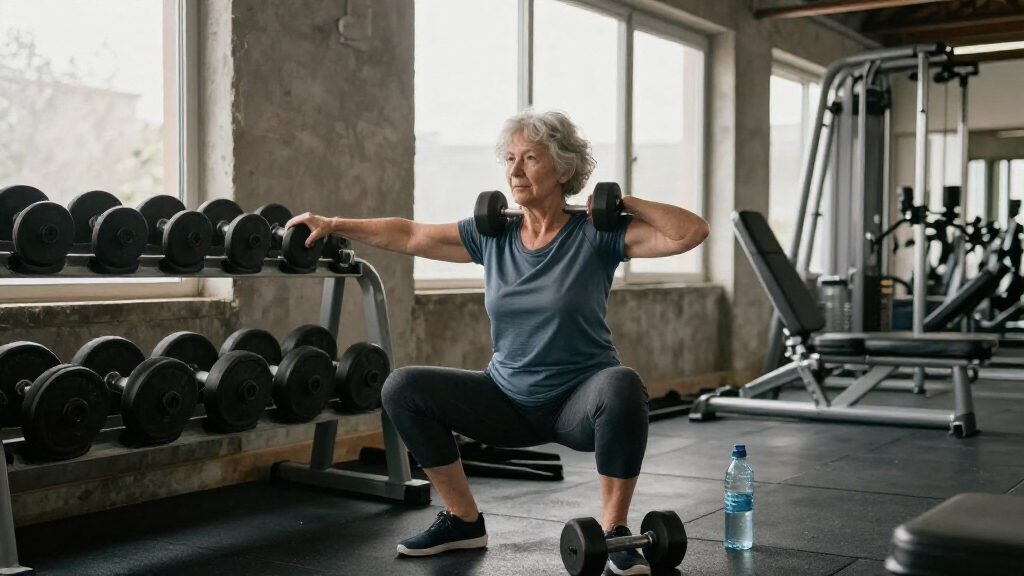
The remaining exercises add strength-pattern practice and resistance. Sherwin’s sequence calls for 10 to 15 squat-to-press repetitions, using dumbbells to move from a squat into an overhead press; 10 to 15 hip hinges; and 10 banded side steps in each direction. The report describes the hip hinge as a forward movement from the hips with a slight knee bend, followed by returning to standing. For the side steps, a loop band sits above the knees while the participant takes steps laterally in a slight squat position.
A Warm-Up Built Around Lifting
The routine offers readers a specific sequence to try before a weight-training session, rather than a general instruction to warm up. Its movements cover several patterns common in strength workouts: stepping and reaching, hip and torso mobility, trunk stability, squatting, hinging and lateral movement. That variety may help someone rehearse movements before beginning their planned exercises, but the article does not compare the sequence with other warm-ups or report measured performance results.
Sherwin told Fit&Well that a warm-up can increase blood flow, improve joint mobility and prepare the body for movement. She also said her own routine helps her focus and activate the muscles she plans to use. Those are attributed explanations, not findings from a trial of this six-move plan. The distinction matters: readers can understand the trainer’s reasoning without treating a suggested routine as a proven way to avoid injury or improve lifting performance.
Products Worth Considering

EGO POWER+ Cordless Leaf Blower, 765 CFM, with 5.0Ah Battery (LB7654)

VEVOR Walk-In Tunnel Greenhouse with Watering System, 15 x 7 x 7 ft

Orbit B-hyve XD 4-Port Smart Hose Watering Timer with Wi-Fi Hub
As an affiliate, we earn on qualifying purchases.
Why the Routine Varies
The Fit&Well report frames warm-ups as something that should be matched to the activity ahead. It contrasts preparation for weight training with preparation for walking or an arm-focused workout, noting that different activities use different areas of the body. Sherwin is identified as a strength-training specialist with Raeya Wellness in Los Angeles.
The report also describes a change in the writer’s own view: the writer says they once regarded warm-ups as brief, perfunctory exercises, then began warming up after learning to do so differently. That is personal experience, not evidence about how all exercisers respond. The article presents Sherwin’s routine as a practical option and includes instructions and suggested durations or repetitions for each movement.
““It helps activate the muscles you’ll be using and allows you to mentally focus before starting your workout.””
— Kelsey Sherwin, as quoted by Fit&Well
Evidence and Adaptations Not Detailed
The report does not give a publication date in the supplied source material, nor does it cite a controlled test of Sherwin’s six-exercise warm-up. It also provides no measured data on lifting performance, injury rates or how long any effects last. The claims about circulation, mobility and injury risk are attributed to Sherwin rather than established as outcomes of this particular routine.
It is also unclear how the sequence should be adjusted for people with injuries, limited mobility, different training plans or no access to dumbbells and resistance bands. The instructions allow the forward step in the stretch to go only as far as a person’s mobility permits, but the article does not offer individualized coaching or alternatives for every movement. Readers should not interpret the routine as medical advice or assume that the same warm-up suits everyone.
How to Use the Sequence
Fit&Well encourages readers to try the six exercises before a weight-training session and observe how they move during the workout. The source does not identify a follow-up study, scheduled update or further announcement. Anyone choosing to use the sequence can follow the stated time and repetition ranges, while adapting activity to their abilities and training plan; people with health concerns or injuries should seek guidance from a qualified professional.
Key Questions
What exercises are in Sherwin’s warm-up?
The six moves are march and reach, the world’s greatest stretch, plank shoulder taps, squat to press, hip hinge and banded side step. The first takes one minute; the stretch is held for 30 seconds per side, and the remaining exercises use the repetitions listed in the report.
How long does the warm-up take?
The report does not give a total duration. It specifies one minute for marching and reaching and 30 seconds per side for the stretch, while giving repetition targets rather than timed durations for the other four movements. Total time will depend on pace and rest.
Does this routine prevent lifting injuries?
The report does not establish that it does. Sherwin says warming up may help prepare the body and reduce injury risk, but no study of this six-move routine or injury data is provided in the article.
Do all six exercises require equipment?
No. The squat-to-press uses dumbbells, and the side steps use a short looped resistance band. The other four movements are described without equipment.
Source: fitandwell.com