TL;DR

Turn quiet afternoons into listening time
- Thousands of audiobooks, podcasts and originals
- Listen on your phone, tablet or Echo — also offline
- Cancel anytime
Cordless leaf blowers that are easy to handle combine manageable ready-to-use weight with good balance, comfortable controls, and adjustable airflow. Match the blower’s CFM, MPH, and battery to your yard and usual debris; for small patios and garden paths, gentle control often matters more than maximum power.
Compare ready-to-use weight with the battery attached, and check how the tool balances in your hand.
Use both MPH and CFM when comparing airflow; nozzle design and debris type also matter.
Choose variable speed to guide leaves around mulch, gravel, and flower beds without scattering them.
Treat runtime claims as estimates tied to a battery, speed setting, and test conditions.
For damp or matted leaves, a rake may be more effective than a blower.
Cordless Leaf Blowers That Are Easy to Handle
A comfortable blower feels balanced with its battery attached and gives you control over airflow. Match its power and runtime to the yard chores you actually do.
Start with a steady, comfortable grip
Ready-to-use weight and balance can matter more than the tool-only figure.
Check with the battery
Battery size and position change how heavy and nose-heavy a blower feels.
Reach controls naturally
A comfortable grip and accessible trigger make frequent pointing and turning easier.
Choose for your yard
A compact handheld model is often easier to maneuver around patios, beds, steps, and cars.
Match airflow to the cleanup
MPH describes air speed; CFM describes how much air moves. Compare both alongside nozzle design and the debris.
- Favor gentle, adjustable airflow.
- Guide dry leaves without scattering mulch or gravel.
- More air volume may help gather dry leaves.
- Wet, matted leaves may be easier to rake.
Use speed to steer, not scatter
Start low, aim down and away from plants, and increase power only when leaves resist.
Use a low setting beside beds, mulch, and gravel.
Move leaves in a shallow arc instead of chasing them around the yard.
A responsive trigger helps you ease off near delicate areas.
Read battery claims in context
Runtime changes with battery capacity, speed setting, temperature, and debris.
| What to check | Why it matters |
|---|---|
| Battery and setting used | High power drains the battery faster. |
| Test conditions | A stated runtime is an estimate, not a promise for every cleanup. |
| Shared battery platform | Compatibility with other garden tools may reduce extra chargers and batteries. |
Choose a blower that feels balanced with its battery attached
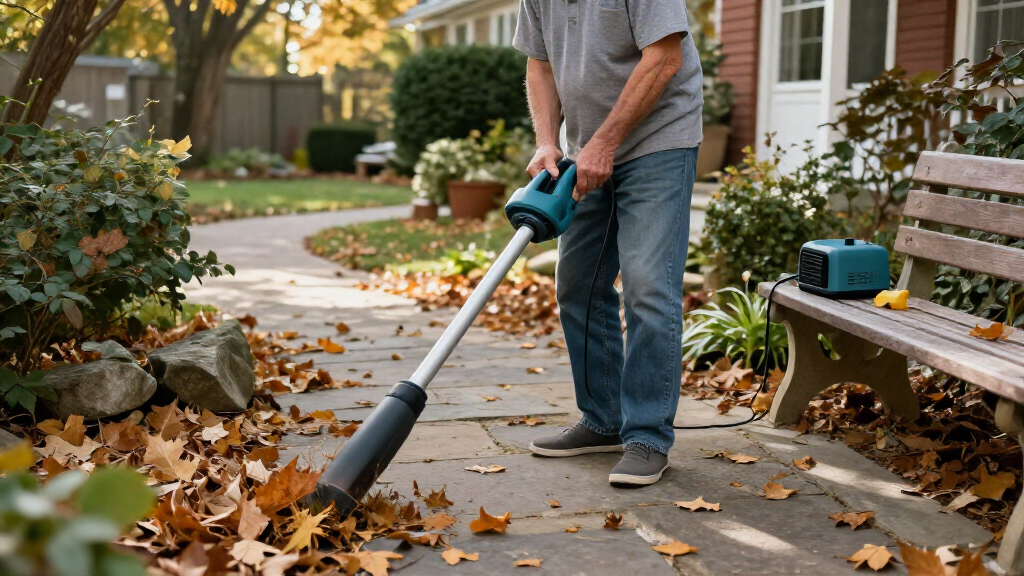
Cordless leaf blowers that are easy to handle feel steady in your hand with the battery installed, and let you point the nozzle without straining your wrist or shoulder. Check the complete operating weight rather than comparing tool-only figures: batteries add weight, and where the motor and battery sit can make a tool feel nose-heavy even when its total weight looks reasonable. That balance affects how much effort it takes to hold the nozzle where you want it. A slightly heavier model with weight near the grip may feel easier to steer than a lighter model that pulls your hand forward. If you can visit a shop, hold the blower as if you were clearing a walkway. Notice whether you can reach the trigger naturally, keep your wrist straight, and angle the nozzle toward the ground without leaning forward. Imagine clearing the dry leaves gathered beside the back steps. A comfortable grip makes that small chore feel like sweeping with a steady broom; a poorly balanced tool can make the same job feel like holding a watering can at arm’s length. The strain can build as you repeatedly lift, turn, and aim, so comfort during one brief hold is only part of the picture. Try changing direction and holding the tool at the angle you would use along an edge. When you cannot handle a model in person, compare its weight with the battery included and look for clear photographs of the grip and battery position. Read specifications carefully: brands may list tool-only weight, battery weight, or a ready-to-use figure. The distinction matters most when you plan to work in short bursts around steps, beds, and parked cars, where frequent pointing and turning call for easy control. If two models seem close in weight, consider which one lets you keep a relaxed wrist and reach the controls without shifting your grip; those details can make regular tidying less tiring.Products Worth Considering

Greenworks 40V Cordless Leaf Blower/Vacuum, 505 CFM, 5.0 Ah Battery and Charger

EGO POWER+ Cordless Leaf Blower, 615 CFM, with 2.5 Ah Battery (LB6151)

EGO POWER+ HT2600 26-Inch Cordless Hedge Trimmer (Battery and Charger Not Included)
As an affiliate, we earn on qualifying purchases.
Use MPH and CFM to match airflow to your yard
MPH measures how fast air leaves the nozzle, while CFM measures how much air the blower moves; both figures help describe performance, and neither tells the whole story alone. A high air speed can help loosen leaves from a crack, while greater air volume can help push a broader scatter across a driveway. The distinction matters because loosening debris and moving a pile are different tasks. Nozzle design and the debris itself also shape what happens in practice, so numbers are most useful when comparing models with similar nozzles and test conditions. For a small patio with dry leaves, you may value controllable airflow more than the biggest advertised number. A strong blast can send mulch onto the flagstones or blow gravel toward the lawn, creating extra cleanup and potentially disturbing garden edges. For a wide drive with a thin layer of dry leaves, more volume may help you gather them into a tidy pile with fewer passes. Damp, matted leaves are harder to move; a rake may work better than trying to chase them with a blower. In that case, more airflow can mean more battery use and noise without solving the underlying problem. Before comparing models, think of one familiar job: clearing the leaves from beneath the bird feeder or sweeping a long garden path. Then compare both MPH and CFM, and seek independent testing or user feedback that describes the type of debris and setting. Those details give you a more useful picture than a single impressive number on a box. If the testing uses dry leaves on a paved surface, for example, it may not predict performance in damp grass or around loose gravel. Match the evidence to your own task and weigh raw output against how precisely you need to direct it.Adjust speed so leaves move without scattering your garden
A variable-speed trigger or dial gives you control over how forcefully the blower moves debris, which helps protect mulch, gravel, flower beds, and the peace of a small yard. The best setting for dry leaves on a paved path may be too strong beside a freshly edged bed. Gentle airflow lets you guide debris instead of sending it flying in every direction. The practical benefit is fewer corrections: if leaves scatter, you spend time gathering them again and may move material you meant to leave in place. Start at a low setting and aim the nozzle down and away from plants, windows, people, and pets. Sweep the air in a shallow arc, moving leaves toward one collection spot rather than chasing individual leaves around the yard. For example, if red maple leaves have gathered along the garden border, a low setting can nudge them onto the path while leaving the dark mulch in place. Increase power only if the leaves resist. This gradual approach also helps you learn how close the nozzle can be before the airflow starts shifting gravel or mulch. A lock-on setting or cruise control can hold a steady speed without requiring constant pressure on the trigger. That can help during a longer driveway cleanup, though a fixed setting may give you less immediate control when you move back near delicate plants. Consider which controls feel easiest to reach and adjust while you hold the tool. A few simple controls you can operate comfortably are more useful than features you rarely use. If your work alternates between open pavement and planting beds, a responsive trigger may be more useful than a setting that holds one speed, because you can ease off as the surroundings change.Estimate battery life from how you actually work
Battery runtime changes with battery capacity, airflow setting, temperature, and the debris you are clearing, so one runtime claim cannot predict every yard chore. High-power settings use energy faster, and a manufacturer’s published figure may reflect a particular battery and lower setting. Check the conditions behind any claim before using it to estimate how long a full cleanup will take. A runtime figure is best treated as a comparison under stated conditions, not a promise that the blower will run that long at full power. Think about the rhythm of your own work. If you clear a small porch and a few steps, you may only need a brief session. If you work along a long fence line or across a large lawn, a larger-capacity battery or a spare may be useful. On a cool autumn morning, you might work in several short stretches, gathering leaves into piles and pausing to empty the collection bag. Your practical runtime depends on that pattern, not just a number printed on the package. A bigger battery can extend the session, but it also adds weight and may change the tool’s balance, so the longest possible runtime is not automatically the most comfortable choice. A battery platform shared with other garden tools can reduce the number of chargers and batteries you keep in the shed. Still, compatibility can depend on voltage, battery generation, and the requirements of each tool. Check the manufacturer’s compatibility information before buying. Also confirm whether the blower includes a battery and charger: a lower tool-only price can look less attractive once you add both. If you already own compatible batteries, that can make a bare tool a practical choice; if not, include the cost and weight of the battery you will need when comparing options.Compare a handheld blower with a backpack model
A compact handheld blower suits many home jobs around patios, steps, garden beds, and cars, while a backpack blower spreads its load across your back for extended work. Handheld models are usually simpler for quick tidying and easier to store; backpack models are larger and may suit bigger properties or longer clearing sessions. The right format depends on your yard and how long you expect to use the tool at a stretch. Carrying a handheld model keeps the setup simple, but your arm supports its full weight; a backpack harness transfers much of the load to your torso, though it takes more effort to put on and maneuver in tight spaces.| Feature | Handheld | Backpack |
|---|---|---|
| Typical home use | Paths, patios, steps, and smaller yards | Longer jobs or larger properties |
| How you carry it | In one hand | On your back, with a handheld tube |
| What to check | Grip, battery weight, and balance | Harness fit, total load, and bulk |
Check comfort, sound, and upkeep before you choose
Comfort depends on more than weight: grip shape, trigger effort, vibration, noise, and nozzle reach all affect how manageable a blower feels. Look for controls you can reach without shifting your grip and a nozzle that reaches the ground without making you bend or twist. If possible, hold the tool in the position you would use to clear the edge of a flower bed or the corner of a garage. These small fit details matter because awkward reach or a stiff trigger can turn a short task into repeated strain, even when the blower itself is light. Cordless models avoid engine exhaust and generally need less routine engine maintenance than gas blowers, but they can still be loud. Follow the manual’s guidance on hearing protection, and wear eye protection when blowing leaves, dust, or small twigs. Keep people and pets away from the area, and direct debris away from doors, windows, neighbors, and parked cars. On a dry day, dust can rise in a fine cloud, so choose a direction that keeps it away from faces and open windows. Noise and dust also affect when and where the tool is comfortable to use, so a powerful blower may be less suitable if you often tidy near open windows or close neighbors. After use, inspect the nozzle and air intake, remove debris as the manual directs, and store and charge the battery according to its instructions. That small routine helps keep the tool ready for the next tidy-up. Recent cordless models commonly feature brushless motors, larger lithium-ion batteries, and shared tool platforms, but specifications and compatibility vary by model. Check current details before buying, especially the included battery, noise rating, runtime conditions, and warranty. The upkeep is simpler than maintaining a gas engine, but battery care and clear air passages still matter: blocked intakes can hinder airflow, while following charging and storage guidance helps you avoid treating a battery as an afterthought.Follow these steps to compare blowers without guesswork
To find a blower that fits, start with your most common cleanup job and compare complete weight, airflow control, and battery details against that task. A short, practical comparison can keep you from paying for power you seldom use or choosing a tool that feels awkward after a few minutes. Try these checks in order, whether you are shopping in person or reading specifications at home. Each check narrows a different tradeoff: comfort, control, runtime, and the effort needed to move your usual debris.- Name the job: Write down the area you clear most often, such as a patio, short path, driveway, or large lawn. The area helps indicate how long you may work and whether you need broad airflow or careful steering.
- Describe the debris: Note whether you usually move dry leaves, grass clippings, dust, or damp, compacted leaves. Different debris resists airflow differently, so a blower that works well on dry pavement may disappoint on wet grass.
- Check ready-to-use weight: Include the battery, then consider balance, grip comfort, and whether the nozzle reaches the ground easily. A comfortable hold makes repeated passes less tiring, while forward-heavy balance can strain your wrist even if the total weight seems modest.
- Compare airflow and controls: Look at both CFM and MPH, and check for a variable-speed trigger or dial that helps you avoid scattering mulch or gravel. More output can reduce passes in open areas, but precise low-speed control matters near beds and loose material.
- Check battery and sound details: Confirm which battery and charger come with the tool, how runtime was measured, whether the battery fits your other tools, and what hearing protection the manual recommends. A larger battery may extend work time but also adds weight, so match capacity to the length of your typical session.