
The best video doorbells for seniors make it easier to see who is at the door without rushing to answer it. My best overall pick is the Tapo 2K Wireless Smart Video Doorbell with Chime for its balance of clear video and a separate indoor chime, while the TKMARS Wireless Doorbell Camera stands out for its indoor monitor and no-subscription approach. For a wired setup with a large screen at home, the 7-inch HD Touchscreen Intercom System is another strong fit. The main tradeoffs are whether to choose a phone-based app or a dedicated screen, battery convenience or wired installation, and cloud features or local, subscription-free use. Read on for how the ten options compare and which one fits different homes and comfort levels.

Turn quiet afternoons into listening time
- Thousands of audiobooks, podcasts and originals
- Listen on your phone, tablet or Echo — also offline
- Cancel anytime
Complete the kit


Key Takeaways
- A separate indoor screen can matter more than extra camera resolution: the wired 7-inch intercom and monitor-equipped TKMARS and Winnes models reduce reliance on a smartphone.
- The Tapo 2K Wireless model is the strongest all-around balance in this lineup: it pairs 2K video with an included chime, while the D225 adds wired-or-battery flexibility for buyers willing to compare installation needs.
- No-subscription choices are not all alike: TKMARS and Anona explicitly advertise no-subscription use, but buyers should still check how footage is stored and retrieved.
- Dual-camera designs target package visibility: eufy E340 and Anona 3K offer a different view strategy from single-camera models, which can matter when deliveries are a concern.
- Wired products trade installation effort for less battery upkeep: the intercom and Google Nest Wired suit homes with compatible wiring, while wireless models are easier to place but need charging or battery maintenance.



| video doorbells for senior | Storage | Video resolution | Night vision |
|---|---|---|---|
| Wired Video Doorbell Intercom | MicroSD, expandable to 512GB | — | Yes |
| BOIFUN Wireless Video Doorbell | — | — | — |
| eufy Security Video Doorbell E | 8GB built-in eMMC | 2K | Color, up to 16 feet (5 m) |
| Tapo 2K Wireless Smart Video D | MicroSD up to 512GB; optional cloud | — | Full color with spotlight |
| TKMARS Wireless Doorbell Camer | — | 1080p | — |
| Winnes Wireless Doorbell Camer | Snapshots without a card; video recording requires a Micro SD card | 1080p | — |
| Anona 3K Dual Cam Video Doorbe | MicroSD up to 512GB; optional cloud storage | 3K 5MP | Color |
| Tapo 2K+ Wired or Battery Powe | MicroSD up to 512GB; optional cloud storage | 2K+ HD | Full color with spotlight |
| Ablink Wireless Video Doorbell | Supports SD cards up to 128GB; card not included | 720p | — |
| Google Nest Doorbell | — | 2K HDR | Yes |
More Details on Our Top Picks
Wired Video Doorbell Intercom System with 7″ HD Touchscreen Monitor, 1080P Camera, 130° Wide Angle, Night Vision, Human Detection, Support 12V Electric Door Lock
The 7-inch touchscreen monitor gives this system a clear advantage for seniors who would rather see visitors on a dedicated indoor screen than reach for a phone. Its wired connection avoids battery recharging, while 1080p video, night vision, and a 130° view cover everyday doorstep checks. It also supports app, RFID, and NFC access, plus a compatible 12V electric lock, offering more entry options than the simpler TKMARS wireless doorbell and monitor setup. Local microSD storage avoids a required monthly fee, but the listing does not describe cloud backup, so footage may depend on the card and system. This is a stronger fit for a planned, permanent installation than for renters: wiring and 12V lock setup can take more effort than choosing the battery-powered BOIFUN.
Pros:- Large 7-inch touchscreen makes visitor video easier to view without relying on a phone.
- Wired connection avoids routine doorbell-battery charging.
- App, RFID, and NFC unlocking offer several ways to manage compatible door access.
- Expandable local microSD storage avoids a required monthly fee.
Cons:- Wired installation is less flexible and may require professional help.
- No cloud backup option is listed, leaving recordings dependent on local storage.
- 12V electric-lock support may require additional equipment or setup.
Best for: Homeowners who want a large, always-available indoor screen and are comfortable arranging wired installation and a compatible electric lock.
Not ideal for: Renters or seniors seeking a quick, wire-free setup; installation requires wiring, and the lock support is limited to 12V.
- Display:7-inch HD touchscreen
- Camera resolution:1080p
- Viewing angle:130°
- Night vision:Yes
- Storage:MicroSD, expandable to 512GB
- Connectivity:Wired
- Door-lock support:12V electric door lock
- Weather resistance:IP65
Our verdict“Choose this system if a large indoor display matters more than easy installation or cloud-backed recordings.”
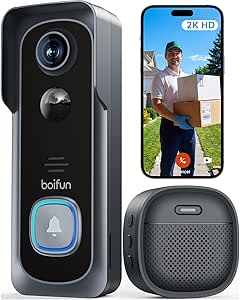
BOIFUN Wireless Video Doorbell Camera, 2K HD
The BOIFUN pairs a 166° field of view with 2K video, making it useful for a senior who wants to check more of the porch without changing position or opening the door. Human detection and two-way audio can help distinguish a visitor from other motion and let the resident answer remotely. Unlike the wired intercom system in this roundup, BOIFUN is battery-powered and does not require doorbell wiring; its local microSD recording also avoids a required subscription. The tradeoff is that its 5200 mAh battery is built in, so recharging means taking the unit down, and the stated battery life depends on laboratory conditions. The Tapo 2K Wireless Doorbell also offers a rechargeable battery and local storage, while this model’s particularly broad view and stated two-year warranty help define its appeal.
Pros:- 166° field of view helps show more of the doorstep and surrounding area.
- Two-way audio and human detection support remote conversations and more relevant alerts.
- Local microSD recording is available without a required subscription.
- IP65 water resistance and night vision rated up to 10 meters suit outdoor use.
Cons:- Built-in battery must be recharged by removing the doorbell.
- Battery life varies with activity and conditions rather than being a guaranteed interval.
- MicroSD card is not included, and Wi-Fi is limited to 2.4 GHz.
Best for: Seniors who want broad porch coverage, two-way conversation, and local recording in a wireless setup, and can manage periodic recharging.
Not ideal for: People who need a fixed indoor monitor or want a removable battery; this model relies on a phone connection and the battery is built in.
- Resolution:2K HD
- Field of view:166°
- Wi-Fi:2.4 GHz
- Battery:5200 mAh built-in rechargeable
- Stated battery life:Up to 60 days under specified laboratory conditions
- Night vision range:Up to 10 meters (33 feet)
- Local storage:MicroSD up to 128GB; card not included
- Weather resistance:IP65
- Warranty:2 years
Our verdict“Pick BOIFUN for a broad, subscription-free wireless view if phone-based alerts and periodic battery recharging work for you.”
eufy Security Video Doorbell E340 with Dual Cameras and 2K Resolution
The E340’s standout feature is its dual-camera design: one camera faces visitors while the downward-facing view helps check for packages. For seniors who cannot easily go to the door, that extra view can answer a practical question a single-camera model may leave unresolved. Its 2K video, color night vision, and two-way talk add useful detail, and 8GB of built-in storage means there is no memory card to buy before using local recording. Compared with BOIFUN, the E340 offers more package-focused coverage and the choice of battery or 16–24V wired power, but has less flexible storage capacity. A compatible chime may need to be purchased separately, so buyers who want an audible alert throughout the home should check their setup before choosing it.
Pros:- Dual cameras show visitors and the area below the door for package checks.
- 2K video and color night vision provide useful detail in low light.
- Built-in local storage works without a subscription or separate memory card.
- Battery and compatible wired power offer installation flexibility.
Cons:- Built-in storage is limited to 8GB.
- A compatible chime may need to be purchased separately.
- Wired installation requires a compatible 16–24V supply.
Best for: Seniors who receive regular deliveries and want to check both visitors and packages, with the option to use battery or compatible wired power.
Not ideal for: Households that need extensive recording capacity or expect a chime to be included; built-in storage is 8GB and a chime may be separate.
- Camera setup:Dual cameras
- Video resolution:2K
- Viewing angle:160°
- Night vision:Color, up to 16 feet (5 m)
- Storage:8GB built-in eMMC
- Power:Rechargeable battery or wired
- Wired power:16–24V
- Audio:Two-way talk
- Smart home compatibility:Compatible chimes, HomeBase devices, Alexa, and Google Assistant
Our verdict“Choose the E340 if package visibility is a priority and its limited built-in storage and chime arrangements suit your home.”
Tapo 2K Wireless Smart Video Doorbell with Chime
The Tapo is a good match for seniors or family caregivers who want a 2K camera with an included chime and the option to review recordings locally or add cloud backup. Its 160° view and full-color night vision with a spotlight help show who is outside, while two-way audio and quick response prompts support a conversation when getting to the door is difficult. Compared with the Eufy E340, it offers optional cloud storage and includes a chime, but it does not have the E340’s second, downward-facing package camera. A 6400mAh rechargeable battery keeps installation wire-free, though the model depends on 2.4GHz Wi-Fi for full functionality and battery life varies with use. Buyers should also plan to supply their own microSD card for local recording.
Pros:- Included chime can provide an audible alert indoors.
- 2K video, 160° view, and full-color night vision with a spotlight aid doorstep checks.
- Two-way audio and quick response prompts help users answer remotely.
- Supports microSD recording and optional cloud backup.
Cons:- MicroSD card is not included.
- Full functionality depends on a 2.4GHz Wi-Fi connection.
- Battery life varies with usage, so charging frequency is not fixed.
Best for: Seniors with reliable 2.4GHz Wi-Fi who want a chime, two-way talk, and a choice between local recording and optional cloud storage.
Not ideal for: People without dependable Wi-Fi or anyone who specifically wants a separate downward package camera; the Eufy E340 better addresses package visibility.
- Resolution:2K
- Field of view:160° diagonal
- Battery:6400mAh rechargeable
- Storage:MicroSD up to 512GB; optional cloud
- Wi-Fi:2.4GHz
- Night vision:Full color with spotlight
- Audio:Two-way audio
- Mounting:Includes 15° angled wedge
Our verdict“Choose the Tapo for a chime-equipped wireless doorbell with flexible storage, provided your Wi-Fi is reliable.”
TKMARS Wireless Doorbell Camera with 1080P Video and PIR Motion Detection, No Subscription, 170° Wide Angle, Night Vision, Indoor Monitor
Unlike the app-centered BOIFUN and Tapo models, the TKMARS pairs its doorbell with an indoor monitor and no-Wi-Fi operation. That can suit seniors who prefer to see the front door on a dedicated screen rather than manage phone notifications or a smart-home account. The 170° view, night vision, and PIR motion detection cover the basic checks, while the listed battery life of four to five months may reduce charging interruptions under suitable conditions. The tradeoff is a more limited feature set: its video is 1080p rather than 2K, and the system requires the indoor monitor. Wireless range is listed as 30–80 meters, so placement between the doorbell and monitor matters. Compared with the 7-inch wired intercom system, TKMARS avoids doorbell wiring but gives up that larger touchscreen.
Pros:- Indoor monitor provides a dedicated way to check the door without using a smartphone.
- No Wi-Fi connection or subscription is required for the described setup.
- 170° view and night vision help cover the approach in varied lighting.
- Listed battery life is four to five months, with actual duration depending on use.
Cons:- The indoor monitor is required for operation, limiting placement flexibility.
- 1080p resolution provides less detail than the 2K BOIFUN, Eufy, and Tapo options.
- Wireless range is listed as 30–80 meters and may constrain monitor placement.
Best for: Seniors who want a phone-free, no-Wi-Fi way to view visitors on an indoor monitor and prefer a straightforward wireless setup.
Not ideal for: Buyers seeking 2K video, app-based remote viewing, or a system that can operate without its indoor monitor.
- Video resolution:1080p
- Viewing angle:170°
- Motion detection:PIR
- Battery capacity:4000mAh
- Listed battery life:4–5 months
- Wireless range:30–80 meters
- Monitor power supply:Type-C
- Connectivity:Wireless doorbell-to-monitor connection; no Wi-Fi required
Our verdict“Choose TKMARS if a dedicated indoor screen and avoiding Wi-Fi matter more than 2K detail or app-based remote access.”
Winnes Wireless Doorbell Camera with 1080p Monitor
I’d choose the Winnes for a senior who wants to see and speak with visitors on a dedicated indoor screen rather than rely on a smartphone. Its 4.3-inch monitor pairs with the camera without Wi-Fi, an app, or a subscription, and the 170° view gives broad coverage of the entrance. Compared with the Ablink, Winnes offers 1080p rather than 720p, which may make faces easier to distinguish on the display. The tradeoff is limited monitoring: the camera can only be viewed when someone rings, so it is not a way to check the porch whenever you choose. The monitor also needs continuous power, and saving video requires a separately purchased Micro SD card. I’d rank it ahead of phone-dependent smart models for straightforward visitor answering, but not for ongoing surveillance.
Pros:- Works without Wi-Fi, an app, or subscription fees.
- 4.3-inch indoor monitor provides a phone-free way to see visitors.
- 1080p video and 170° viewing angle cover a broad entrance view.
- Two-way audio and IP65 water resistance.
Cons:- Camera view is available only when someone rings the doorbell.
- Indoor monitor must remain connected to power.
- Video recording requires a Micro SD card, sold separately.
Best for: Seniors who want a dedicated indoor screen and two-way conversation without setting up Wi-Fi, a smartphone app, or a subscription.
Not ideal for: People who want to check a live camera feed at any time or need a portable monitor that can stay unplugged.
- Video resolution:1080p
- Viewing angle:170°
- Display:4.3-inch IPS screen
- Connection:2.4 GHz Bluetooth
- Audio:Two-way audio
- Battery:1000mAh; listed for 800–900 rings per charge
- Weather resistance:IP65
- Storage:Snapshots without a card; video recording requires a Micro SD card
Our verdict“Choose Winnes if a simple, dedicated screen matters more than being able to check the porch on demand.”
Anona 3K Dual Cam Video Doorbell Camera Wireless No Subscription with Chime
The Anona suits households that want more than a basic doorbell view: its dual cameras and 3K 5MP resolution are designed to show both the main approach and the area near the doorstep. People, pets, and package detection can help distinguish relevant activity, while local microSD storage avoids a required subscription for those features. Compared with the Winnes and Ablink, Anona offers richer monitoring features and does not depend on a small indoor display; the tradeoff is that it needs Wi-Fi for full functionality, which can mean more setup and reliance on a phone or compatible smart-home system. Seniors who prefer a dedicated screen and an offline connection may find the Winnes easier to use. Anona’s wired or battery power gives installation flexibility, but its memory card is not included.
Pros:- Dual cameras provide views of the entrance and doorstep area.
- 3K 5MP video and color night vision support detailed viewing.
- People, pet, and package detection with local storage available without a required subscription.
- Can be wired or battery-powered, with a listed battery life of up to 100 days.
Cons:- Full functionality requires Wi-Fi.
- MicroSD card is not included.
- AI alerts and camera settings may be more involved than a simple indoor-monitor system.
Best for: Seniors or family caregivers who want detailed views of the doorstep and approach, with AI alerts and local recording through an existing Wi-Fi setup.
Not ideal for: People who want a phone-free doorbell, have unreliable or unavailable Wi-Fi, or prefer the simplest possible controls.
- Video resolution:3K 5MP
- Camera views:Dual cameras
- Night vision:Color
- AI detection:People, pets, and packages
- Power:5200mAh rechargeable battery or wired
- Listed battery life:Up to 100 days
- Storage:MicroSD up to 512GB; optional cloud storage
- Wi-Fi:Wi-Fi 6, 2.4GHz
- Weather resistance:IP65
Our verdict“Pick Anona for feature-rich, dual-view monitoring if Wi-Fi and app-based setup are comfortable for the household.”
Tapo 2K+ Wired or Battery Powered Smart Video Doorbell with Chime, D225
I’d point seniors who already use a smart speaker or want family members to help manage alerts toward the Tapo D225. Its 2K+ video, 180° view, color night vision, and AI detection for people, packages, and vehicles give it more monitoring range than the Winnes or Ablink, whose strengths are simpler indoor-screen use. The D225 can connect to Alexa and Google Assistant, and quick responses can make answering a visitor easier when speaking live is inconvenient. It also supports either wired power or a rechargeable battery, so installation can fit more homes. The cost of that flexibility is smart-home dependence: it requires 2.4 GHz Wi-Fi, not 5 GHz, and local recording needs a separate MicroSD card. I’d skip it for anyone who wants an offline, screen-first doorbell.
Pros:- Wired or battery operation accommodates different entryway setups.
- 2K+ video and a 180° field of view cover a broad area.
- AI detection includes people, packages, and vehicles.
- Color night vision, two-way audio, and quick responses support varied visitor interactions.
Cons:- Requires 2.4 GHz Wi-Fi and does not support 5 GHz networks.
- MicroSD card is not included; cloud storage is optional.
- Smart features may be less straightforward for someone who does not use apps or voice assistants.
Best for: Seniors with reliable 2.4 GHz Wi-Fi who want family-assisted alerts, smart-speaker compatibility, and a choice of wired or battery power.
Not ideal for: People without Wi-Fi, users whose network only supports 5 GHz, or anyone who wants a dedicated monitor instead of app-based access.
- Video resolution:2K+ HD
- Field of view:180°
- Power:Wired (8–24V) or 10,000mAh battery
- Listed battery life:Up to 8 months
- Night vision:Full color with spotlight
- Detection:AI detection for persons, packages, and vehicles
- Storage:MicroSD up to 512GB; optional cloud storage
- Wi-Fi:2.4 GHz only
- Smart-home compatibility:Alexa and Google Assistant
Our verdict“Choose the D225 when flexible power and smart-home alerts matter more than an offline, dedicated-screen experience.”
Ablink Wireless Video Doorbell with 4.3-Inch Display
Ablink keeps the interaction familiar: a visitor rings, and the 4.3-inch indoor display lets the resident see and speak with them without opening an app. It works without Wi-Fi or a subscription, making it a simpler fit than the Tapo D225 or Google Nest for someone who does not want notifications routed through a smartphone. The tradeoff is image detail: its 720p resolution is lower than the Winnes 1080p and the smart models’ higher-resolution video. It also offers infrared night vision rather than the color night vision found on Anona and Tapo. The display can run unplugged for up to six hours, but it needs power for longer use; local recording requires a separate SD card. I’d choose Ablink for straightforward answering, not for detailed or continuous surveillance.
Pros:- Works without Wi-Fi, an app, or subscription fees.
- 4.3-inch IPS display offers a phone-free way to view visitors.
- Two-way audio and infrared night vision are included.
- Supports adhesive mounting or drilling.
Cons:- 720p resolution is lower than the Winnes 1080p and smart models in this roundup.
- Display lasts up to six hours unplugged and needs power for longer use.
- SD card for local recording is not included.
Best for: Seniors who want a basic indoor-screen doorbell, do not use Wi-Fi or apps, and value simple two-way conversations over high-resolution footage.
Not ideal for: People who need sharper video, want color night vision, or expect the indoor display to work unplugged throughout the day.
- Video resolution:720p
- Display:4.3-inch IPS
- Wireless connection:2.4GHz
- Audio:Two-way audio
- Storage:Supports SD cards up to 128GB; card not included
- Camera battery life:1–3 months
- Display battery life:Up to 6 hours unplugged
- Charging time:2–3 hours
- Mounting:Adhesive mounting or drilling
Our verdict“Choose Ablink for simple, phone-free visitor answering if 720p video meets your needs.”
Google Nest Doorbell (Wired, 3rd Gen) – 2K Video, Live View – Hazel
The wired Nest makes the most sense for a senior whose household already uses Google Home, especially when relatives can help manage setup and notifications. Its 2K HDR video, 166° field of view, and night vision offer a more detailed smart-camera experience than the screen-based Winnes and Ablink. A wired power connection also removes the routine of recharging a doorbell battery. That convenience comes with a fixed-installation limit: the Nest needs an existing compatible wired connection, while the Tapo D225 can run on battery when wiring is not practical. Nest also relies on Wi-Fi and Google Account integration, and some advanced features require a Google Home Premium subscription. I’d favor it over the Anona for a household already centered on Google Home, but not for anyone seeking an offline doorbell or a dedicated indoor display.
Pros:- 2K HDR video and night vision support detailed visitor viewing.
- 166° field of view captures a broad area.
- Wired power avoids periodic battery recharging.
- Google Home integration and encrypted data security.
Cons:- Requires a wired power connection, limiting placement options.
- Requires Wi-Fi and Google Account integration.
- Some advanced features require a Google Home Premium subscription.
Best for: Seniors in a Google Home household who have compatible doorbell wiring and a family member available to help with app and account setup.
Not ideal for: People without doorbell wiring, those who want a phone-free indoor monitor, or households that prefer to avoid Wi-Fi and subscription-dependent features.
- Video resolution:2K HDR
- Field of view:166°
- Night vision:Yes
- Connectivity:Wi-Fi
- Power source:Corded electric
- Smart-home integration:Google Home
- Security:Encrypted data security
- Color:Hazel
Our verdict“Choose Nest if you have compatible wiring and already rely on Google Home; otherwise, the battery-powered Tapo D225 is more flexible to install.”

How We Picked
I ranked these doorbells by how well their stated features address senior-specific needs: seeing visitors clearly, hearing or noticing alerts indoors, and avoiding unnecessary phone steps. I gave particular weight to dedicated monitors or included chimes, usable video resolution and viewing angles, installation demands, and whether a subscription is presented as necessary for the intended use. I also weighed flexibility, such as wired-or-battery operation, against ongoing upkeep.
The order favors models that combine clear visitor viewing with an accessible alert path and manageable day-to-day ownership. A large indoor display or chime can be more useful than a higher resolution when the user does not want to depend on a phone. Specialized picks rank lower for general use when they involve more involved wiring, narrower appeal, or tradeoffs that matter mainly to particular households. Product details and recording terms can vary by configuration, so buyers should confirm compatibility and storage conditions before choosing.
| video doorbells for senior | Night vision |
|---|---|
| Wired Video Doorbell Intercom | Yes |
| BOIFUN Wireless Video Doorbell | — |
| eufy Security Video Doorbell E | Color, up to 16 feet (5 m) |
| Tapo 2K Wireless Smart Video D | Full color with spotlight |
| TKMARS Wireless Doorbell Camer | — |
| Winnes Wireless Doorbell Camer | — |
| Anona 3K Dual Cam Video Doorbe | Color |
| Tapo 2K+ Wired or Battery Powe | Full color with spotlight |
| Ablink Wireless Video Doorbell | — |
| Google Nest Doorbell | Yes |
Factors to Consider When Choosing Best Video Doorbells For Seniors
Before choosing a model, I would start with how the person will actually answer the door: by checking a phone, looking at a screen inside, or listening for a chime. Then match the device to the home’s wiring, Wi-Fi coverage, delivery patterns, and willingness to manage charging or an app. These practical details often shape daily comfort more than a longer feature list.
Choose the Alert Method Before Comparing Camera Specs
A doorbell is only helpful if its alert reaches the person in a way they notice. A phone notification may suit someone who keeps a smartphone nearby, but it can be easy to miss when the phone is muted, charging, or in another room. An included chime or indoor monitor gives the household another way to hear or see a visitor without opening an app. Check whether the chime is included, where it can be placed, and whether its sound or screen is suitable for the home. A common mistake is to choose a camera first and only later discover that alerts depend on a phone the user rarely checks.
Match the Installation to the Home and the Person Doing the Setup
Battery-powered models can avoid changes to existing wiring, which helps renters or households that want a simpler installation. Their tradeoff is that someone must monitor battery status and recharge or replace batteries when needed. Wired doorbells avoid routine charging but require compatible wiring, and an intercom system may call for more involved installation than a basic replacement doorbell. Before buying, check the existing chime and transformer requirements against the manufacturer’s instructions, and decide who will handle setup and future maintenance. Do not assume that a product labeled wired will connect directly to every existing doorbell circuit.
Decide Whether a Dedicated Monitor or a Smartphone App Is Easier
A dedicated display can offer a straightforward way to check the door without navigating a phone app, accounts, or notification settings. That benefit depends on the screen’s placement: a monitor across the house may be less useful than a phone already carried throughout the day. App-based models can make remote viewing easier for relatives or caregivers, but they introduce setup, password, and software-update tasks. Consider who will manage those tasks and whether more than one household member needs access. The simplest arrangement is often the one the resident can use independently, with a trusted helper available for setup rather than every visitor alert.
Check Recording and Subscription Terms, Not Just the No-Subscription Label
Some buyers want to view a live visitor without paying for a recording plan, while others want saved clips to check missed deliveries or unfamiliar visitors later. Those are different needs: no-subscription operation does not automatically mean every recording feature is included or stored in the same way. Confirm whether recordings use local storage or cloud storage, how long clips remain available, and what features require an account or plan. Also check whether footage can be reviewed easily by the resident or a family member. Choosing based only on the phrase no subscription can lead to disappointment if the desired history or sharing tools are not part of the basic setup.
Prioritize the View That Solves the Household’s Main Problem
Higher resolution can help make a visitor easier to identify, but the camera’s angle and placement determine what appears in the image. A broad horizontal view may help with a wide porch, while a second camera can offer added visibility near the doorstep or packages. Think about whether the main concern is recognizing a person, seeing parcels, or covering an approach with an awkward angle. Night vision and motion detection can help after dark or when someone does not press the button, but sensitivity and placement affect how often alerts arrive. Avoid paying attention to resolution alone when a blocked view, poor mounting position, or frequent false alerts would matter more.
Plan for Wi-Fi, Household Support, and Long-Term Upkeep
Video doorbells rely on a stable connection between the door, home network, and any phone or monitor used to view alerts. A weak signal near the entrance can cause delayed notifications or interrupted live view, so test coverage there before settling on a model. Also ask who will update the app, manage access if a caregiver changes, and troubleshoot a disconnected device. A simpler system may be a better fit when regular technical help is unavailable, even if another model offers more camera features. Think through maintenance over a full year, including battery checks, software access, and who can respond if the doorbell stops working.
Frequently Asked Questions
Is a video doorbell with an indoor monitor better for someone who does not use a smartphone?
Often, yes, because a dedicated monitor can show or announce a visitor without requiring the resident to open an app. The benefit depends on screen placement, alert visibility, and how easy its controls are to use. A monitor-equipped model can still have setup needs, so someone may need to configure the camera, connection, and user access. If relatives also need to check the door remotely, confirm that the chosen system supports their access separately. For someone who already uses a phone comfortably, an included chime may be enough without adding a screen.
Should I choose a battery-powered or wired video doorbell for an older homeowner?
Choose based on who will handle installation and future upkeep rather than age alone. Battery models avoid relying on existing doorbell wiring, but someone must monitor and recharge or replace the battery. Wired models can reduce that routine task, though compatibility and installation may require help. If the home has reliable existing wiring and a trusted installer, wired can be a practical long-term choice. If wiring is uncertain or installation changes are unwelcome, a battery model may be easier to place.
Can a senior use a video doorbell without paying for a subscription?
Some models advertise use without a subscription, but the exact experience depends on whether the person needs live viewing, saved clips, or longer video history. Check where recordings are stored and which features remain available without a paid plan. A doorbell may still send alerts and show a live feed while offering limited access to past events. If reviewing missed visitors or deliveries is important, verify the storage method and clip-retention terms before purchase. Do not treat a no-subscription label as a guarantee that every recording feature is included.
Do dual-camera doorbells make it easier to see delivered packages?
They can help when one view is aimed at visitors and another covers the area closer to the doorstep, but the result depends on camera placement and the porch layout. A second camera does not fix a blocked lens, poor Wi-Fi, or a parcel left outside the camera’s field of view. Compare the actual viewing angles and check whether the doorbell can be mounted at a useful height. For a household mainly concerned with packages, a clear view of the delivery area matters more than camera count alone. The eufy E340 and Anona 3K are the dual-camera options in this roundup, but each still needs a suitable mounting position.
What should I check before buying a video doorbell for a home with weak Wi-Fi near the entrance?
First, test the existing Wi-Fi at the planned mounting spot rather than relying on signal strength elsewhere in the house. A weak connection can delay alerts or interrupt live video, reducing the value of features the resident expects to use. Check the manufacturer’s connection requirements and whether the household can improve coverage with router placement or a compatible network extender. Also consider whether the doorbell’s indoor monitor or chime depends on the same network for its core alerts. If the signal cannot be improved, choose a setup whose essential functions still fit the home’s connection limits.
Conclusion
For most households, I would start with the Tapo 2K Wireless Smart Video Doorbell with Chime as the best overall balance of clear video and an indoor alert. My best value pick for buyers who want a dedicated display and subscription-free positioning is the TKMARS Wireless Doorbell Camera; confirm its recording setup before purchase. For a best premium direction, compare the Google Nest Doorbell Wired for a connected wired setup or the eufy E340 for dual-camera coverage, depending on whether app-based features or package visibility matter more. Beginners who want an included chime and a less involved battery installation should look at the Tapo 2K Wireless. For specific needs, choose the 7-inch wired intercom when a large home screen and electric-lock support are priorities, or the Anona 3K when dual views and no-subscription use are the draw. The best fit is the one the resident can respond to comfortably and the household can maintain.