
TL;DR

Turn quiet afternoons into listening time
- Thousands of audiobooks, podcasts and originals
- Listen on your phone, tablet or Echo — also offline
- Cancel anytime
Researchers at Nottingham Trent University and Integrated System Technologies developed and tested a home-monitoring prototype that combines radar, low-resolution thermal sensors and smart plugs. In a mock-home study, using the sensors together improved activity-recognition performance; the report does not establish that the system can reliably detect medical emergencies in real homes.
Nottingham Trent University researchers have developed and tested a home sensor prototype that combines radar, low-resolution thermal sensing and smart plugs to track older people’s everyday activity without cameras or wearable devices. The team says the system could alert caregivers to possible emergencies or changes in routine, but the reported testing took place in a mock domestic environment, not in residents’ homes.
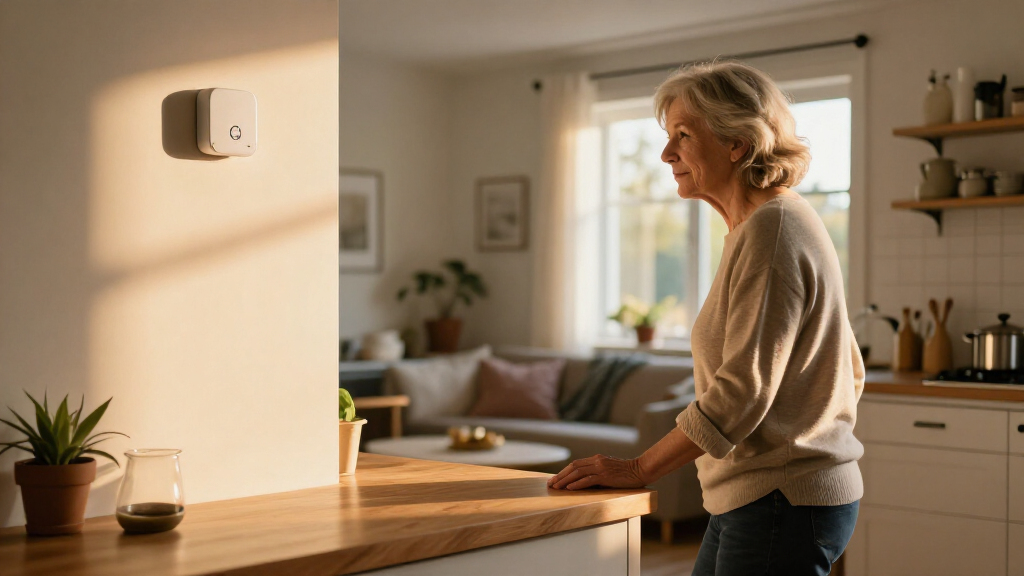
The system uses millimeter-wave radar to detect movement, thermal sensors to identify broad postures such as sitting, standing, walking or lying down, and smart plugs to monitor activity involving household appliances. The plugs can track patterns linked to everyday tasks, including making a drink or preparing food. Researchers say the thermal output is kept at low resolution and does not show facial features or personal identity.
Artificial intelligence combines information from the three technologies and learns an individual’s patterns over time. The researchers say it could flag unusual behavior, including prolonged inactivity or a departure from a person’s usual routine. If a possible emergency is detected, the system is designed to notify care professionals or loved ones, who could check on the resident remotely or in person.
For the study, the team assessed the sensors in a mock domestic environment with six room layouts, including bedrooms and living areas with different furniture arrangements. They recorded a series of activities and found that combining sensor data improved performance in identifying movement and posture compared with relying on the technologies separately. The report does not provide evidence from a long-term trial in occupied homes or confirm clinical detection of falls, heart attacks or strokes.
How Home Monitoring Could Help
The proposed approach addresses a practical tension in care: some older adults want to remain in their homes, while families and professionals may need a way to notice when daily functioning changes or urgent help is needed. A system that monitors routines without conventional cameras or wearable equipment could offer another option for checking on a resident, particularly when a person may not be able or willing to use a device.
Researchers also suggest routine changes could provide an early indication of declining mobility or well-being. That possibility is not the same as diagnosing a condition. The published work describes activity recognition in a controlled setting; it does not show that the prototype can determine the cause of a change or replace direct assessment by a care professional. Its potential value will depend on reliable alerts, appropriate follow-up and whether residents accept monitoring in their homes.
home activity monitoring sensors for seniors
As an affiliate, we earn on qualifying purchases.
As an affiliate, we earn on qualifying purchases.
How the Prototype Was Tested
The research, titled “Privacy-Preserving Ambient Sensing for Activities of Daily Living: Multimodal Radar-Thermal Human Activity Recognition and Smart Plug Appliance Recognition,” was published in the journal Sensors in 2026. The work was carried out by Nottingham Trent University (NTU) researchers in collaboration with Integrated System Technologies Ltd.
Each sensor contributes a different kind of information: radar detects movement, thermal sensors estimate posture without providing a conventional image, and smart plugs register patterns in appliance use. The study’s six mock-room arrangements were intended to test the system across different domestic layouts. The authors report that combining the inputs improved recognition performance, but the provided report does not give detailed accuracy figures or establish how well the system would perform amid the variation of day-to-day life in occupied homes.
“By combining these three technologies, we can establish a complete picture of how someone is coping at home.”
— Dr. Yangang Xing, lead researcher at Nottingham Trent University’s School of Architecture, Design and the Built Environment
elderly emergency alert sensor system
As an affiliate, we earn on qualifying purchases.
As an affiliate, we earn on qualifying purchases.
Limits of the Current Evidence
The reported work does not establish real-world emergency detection accuracy, how often the system might issue false alerts, or whether it can reliably distinguish a health crisis from an ordinary change in routine. The source describes mock-home testing and reports improved combined performance, but does not provide figures in the report for sensitivity, specificity or the number of events detected.
It is also unclear how the system would be installed and maintained in different homes, how its alerts would fit into care services, and how residents would control or consent to data collection. The researchers describe privacy protections in the thermal output, but details about data storage, access and security are not provided in the report. No information is given on a timetable for deployment, cost to households, or testing with older adults living independently.
motion detection radar thermal sensors
As an affiliate, we earn on qualifying purchases.
As an affiliate, we earn on qualifying purchases.
Further Testing Before Home Use
The study establishes a prototype and reports that combining radar, thermal sensing and smart-plug data performed better in the team’s mock-home tests. The source does not announce a date for a next trial or a commercial launch. Further evaluation would need to show how well the system works in occupied homes over time, how it handles varied routines and layouts, and whether alerts reach caregivers accurately and promptly.
Until such evidence is reported, the system should be understood as a research development with a possible role in future ambient-care services, rather than an established emergency-response product. The researchers’ proposed next step is not specified in the report, so the timing and design of any real-home testing remain unknown.
smart plugs for elderly home safety
As an affiliate, we earn on qualifying purchases.
As an affiliate, we earn on qualifying purchases.
Key Questions
What does the home sensor system monitor?
It combines radar movement data, low-resolution thermal information about posture and smart-plug patterns associated with appliance use. The system is designed to learn a resident’s usual activity patterns and flag unusual changes.
Does the system use cameras or wearable devices?
The prototype is described as monitoring without intrusive cameras or wearable devices. Its thermal sensors produce low-resolution output intended to show broad posture without revealing faces or personal identity.
Has it been shown to detect falls or heart attacks reliably?
No such reliability is established by the report. The researchers describe possible detection of emergencies, but the reported evaluation was in a mock domestic environment and focused on recognizing activity and posture.
Where was the system tested?
Researchers tested it in a mock domestic environment with six room layouts and varying furniture arrangements. The report does not describe a long-term trial in older people’s occupied homes.
When could older people use it at home?
The report gives no launch date or schedule for home deployment. More information about real-world performance, installation, costs and care-service response would be needed before its availability can be assessed.
Source: rss
Fall Picks
fall essentials
As an affiliate, we earn on qualifying purchases.