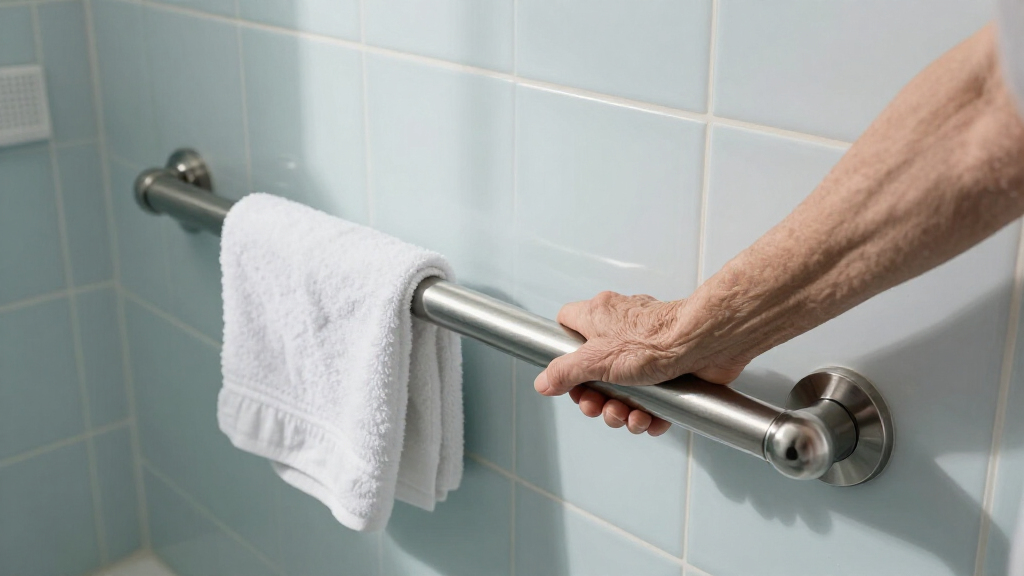

When choosing fall-prevention grab bars for an older adult, the main decision is not simply which bar is easier to install. It is whether the bar will be used for steadying and balance or relied on to support substantial body weight during a transfer. Permanently installed grab bars, when correctly anchored into suitable structure, are the stronger choice for recurring support near a toilet, shower, or tub. Suction-cup bars offer a less permanent, more flexible option, but their grip depends on a compatible, clean, smooth surface and can change over time.

Turn quiet afternoons into listening time
- Thousands of audiobooks, podcasts and originals
- Listen on your phone, tablet or Echo — also offline
- Cancel anytime

TAILI 16.8-inch Suction Shower Grab Bars, 2 Pack, Grey
- ✔ Brand: TAILI
- ✔ Pack size: 2 bars
- ✔ Length: 16.8 inches

LEVERLOC Grab Bars for Shower, 2 Pack, 16.8 inches, Grey
- ✔ Brand: LEVERLOC
- ✔ Pack size: 2 bars
- ✔ Length: 16.8 inches

LEVERLOC 2 Pack Suction Grab Bars for Bathtubs and Showers, 12 Inch Waterproof Bathroom Safety Handles for Seniors and Elderly
- ✔ Brand: LEVERLOC
- ✔ Pack size: 2 bars
- ✔ Length: 12 inches
This comparison focuses on those two common approaches. It weighs support reliability, installation, placement, portability, upkeep, and value. Choose a fixed bar for a high-risk location or anyone who may pull hard on the rail; consider suction cups only for light balance assistance where the surface and the user’s needs make them appropriate. Neither option replaces a broader fall-prevention plan or an assessment by a qualified professional when balance or mobility is changing.
At a Glance
| Criteria | Permanently installed grab bars | Suction-cup grab bars | Winner |
|---|---|---|---|
| Support reliability | High when the bar is correctly installed into appropriate structural support and checked periodically. | Variable; depends on surface compatibility, cleanliness, seal condition, and correct attachment. | A |
| Suitable use | Best for recurring support during transfers or movement where a user may put substantial weight on the bar. | Limited to light balance assistance; not a dependable choice for pulling up or supporting body weight. | A |
| Installation | Requires correct positioning, suitable anchors or framing, and often professional installation. | Quick attachment without drilling, but careful placement and seal checks are necessary. | B |
| Placement flexibility | Less flexible after installation; location should be planned around the user and task. | High on smooth, nonporous surfaces that match the product’s requirements. | B |
| Portability and reversibility | Low; removing or relocating it can leave holes and require repair. | High; can be removed or repositioned without permanent holes. | B |
| Inspection and upkeep | Check for movement, loose hardware, corrosion, and surface damage. | Frequent seal checks and reattachment as needed; inspect before each use. | A |
| Cost and long-term value | Higher initial cost, usually stronger value for permanent, weight-bearing use. | Lower upfront cost, but poor value if the user needs reliable weight-bearing support. | Depends |
TAILI 16.8-inch Suction Shower Grab Bars, 2 Pack, Grey
For shoppers seeking a pair of longer suction handles, TAILI is the most balanced choice in this group. Each bar is 16.8 inches long, matching the longer LEVERLOC model and offering more room to position a hand than the 12-inch LEVERLOC. The pair format also lets us place support at more than one point, provided the surfaces and placement meet the manufacturer’s instructions.Its most distinctive detail is the stated 240-pound maximum load capacity. That is useful information to compare against the other listings, which do not provide a comparable capacity figure, but we should not confuse it with a guarantee that the bar is suitable for pulling up or supporting full body weight. TAILI’s description emphasizes balance and bathroom support, and suction-mounted equipment remains dependent on a compatible surface and correct attachment. Buyers should verify intended use directly in the instructions before relying on it.Compared with the longer LEVERLOC, TAILI makes its capacity claim more explicit; LEVERLOC, in turn, highlights its patented suction design and anti-slip grip. TAILI includes anti-slip strips and is described as reusable and removable without wall damage, making it a practical candidate for smooth tile, glass, or marble. Its clear downside is the same condition that applies to all suction picks: uneven or porous walls are out, and suction can lose grip if installation or surface compatibility is wrong. Choose it for an added balance point, not as a substitute for a professionally mounted grab bar when a senior needs weight-bearing support.
Pros:
- 16.8-inch length offers more hand-placement room than the 12-inch LEVERLOC.
- Two bars can provide balance points in more than one location.
- Includes anti-slip strips and is described as reusable and removable without wall damage.
- Lists a 240-pound maximum load capacity, a specification not supplied for the other two models.
Cons:
- Suction is limited to smooth, non-porous surfaces and can lose grip if installed incorrectly or on an unsuitable surface.
- The stated capacity must not be assumed to mean safe support for pulling up or carrying full body weight.
- Requires users or caregivers to follow installation directions and check that the suction remains secure.
Best for: Seniors who need a longer balance handle on a confirmed smooth, non-porous surface and want a stated capacity figure to compare.
Not ideal for: Anyone who needs a bar to pull up, transfer full body weight, or attach to textured, porous, uneven, or otherwise incompatible walls.
Bottom line: We rank TAILI first for its longer reach, two-bar setup, and more explicit capacity information, while treating it strictly as a surface-dependent balance aid.
“We rank TAILI first for its longer reach, two-bar setup, and more explicit capacity information, while treating it strictly as a surface-dependent balance aid.”
LEVERLOC Grab Bars for Shower, 2 Pack, 16.8 inches, Grey
When reach matters more than compact placement, this 16.8-inch LEVERLOC pair is the closest alternative to TAILI. Its length matches the top-ranked model, so it offers more room for hand placement than the 12-inch LEVERLOC. The listing emphasizes a fast, tool-free installation, an anti-slip grip, and reusable suction that is intended not to leave marks on tile. Those details make it a reasonable option for a bathroom where drilling is not wanted or permitted.LEVERLOC differentiates this model with its claim of patented octopus bionic suction technology. That may appeal to buyers comparing suction designs, but it does not remove the central limitation: the bars are described as suitable only for smooth, non-porous surfaces such as tile or glass. Just as importantly, the listing says they provide balance assistance and cannot support full body weight. That explicit warning makes the intended role clearer than a vague promise of “safety,” but it also rules this pair out for anyone who must lean heavily or pull themselves up.Compared with TAILI, this model has the same 16.8-inch reach but does not supply a listed maximum capacity in the provided specifications. TAILI is therefore easier to compare on that particular spec, while LEVERLOC highlights its grip and quick setup. Against the 12-inch LEVERLOC, this pair is better suited to a broader hand-placement area but needs more wall space. Buyers should prioritize surface compatibility and a careful pre-use check over claims of quick attachment; a suction bar is only useful while securely attached and within its stated balance-assistance role.
Pros:
- 16.8-inch length matches TAILI and provides more reach than the 12-inch LEVERLOC.
- Anti-slip grip is intended to improve hand contact in a wet bathroom.
- Designed for tool-free installation and reuse on suitable surfaces.
- The listing clearly states that it is for balance assistance, not full body weight.
Cons:
- Limited to smooth, non-porous tile or glass surfaces.
- No maximum load capacity is included in the supplied specifications.
- Longer size may not fit compact placement areas as easily as the 12-inch model.
Best for: A senior or caregiver wanting a longer, tool-free balance handle for a suitable tile or glass surface, without needing a weight-bearing support bar.
Not ideal for: People who need substantial weight-bearing support, a stated load capacity for comparison, or a handle for rough, porous, or uneven walls.
Bottom line: We recommend this LEVERLOC when shoppers want 16.8-inch reach and a clearly stated balance-only role, but not when they need a weight-bearing grab bar.
“We recommend this LEVERLOC when shoppers want 16.8-inch reach and a clearly stated balance-only role, but not when they need a weight-bearing grab bar.”
LEVERLOC 2 Pack Suction Grab Bars for Bathtubs and Showers, 12 Inch Waterproof Bathroom Safety Handles for Seniors and Elderly
The 12-inch LEVERLOC earns its place for tight placement areas, where a longer handle may not fit. It comes as a pair and uses a suction-mounted design, so it can be installed without drilling on an appropriate smooth surface. Its curved grip and non-slip features are intended to help provide a handhold for balance in the bath or shower. If the intended role is a light stabilizing cue rather than a pull-up bar, this shorter size may be easier to position near a specific step or transfer point.The compromise is reach. Compared with both 16.8-inch models, this bar offers less length for adjusting where the hand lands. That can matter for seniors whose balance varies or who need a wider target when reaching. Its listing is also explicit that the handle is not designed to support body weight, so shoppers should not treat the ergonomic grip or waterproof finish as evidence of weight-bearing capability.For a buyer choosing between LEVERLOC models, the decision is straightforward: select this pair when wall space is limited and a shorter balance handle suits the placement; choose the 16.8-inch version when extra reach is more important. TAILI is the stronger comparison if a stated maximum capacity is a relevant spec, though that claim likewise should not override the bar’s intended use and installation guidance. This compact LEVERLOC still depends on smooth, non-porous tile or similar surfaces. Skip it if the wall is textured, if the needed grip span is broad, or if the user must lean heavily on the handle.
Pros:
- 12-inch length can fit a more compact area than either 16.8-inch option.
- Pair format provides two handles for separate suitable locations.
- Tool-free suction installation avoids drilling or permanent mounting.
- Curved, non-slip grip is designed for balance assistance in wet settings.
Cons:
- Shorter reach offers less hand-placement flexibility than the two 16.8-inch pairs.
- The listing says it is for balance assistance, not supporting body weight.
- Requires a smooth, non-porous compatible surface and secure installation.
Best for: Seniors who need a compact balance aid for a small, suitable smooth-surface placement and do not need a long grip span.
Not ideal for: People who need a longer handhold, need to support or transfer body weight, or have a bathroom wall that is textured, porous, or uneven.
Bottom line: We choose the shorter LEVERLOC for restricted space, but favor either longer model when a wider hand-placement area is more important.
“We choose the shorter LEVERLOC for restricted space, but favor either longer model when a wider hand-placement area is more important.”
As an Amazon Associate we earn from qualifying purchases.
Key Differences
The most consequential gap is reliability under load. A fixed bar can provide meaningful support when it is mounted at the right height and angle and fastened into appropriate structural material. That makes it the better choice for actions such as lowering onto or rising from a toilet, stepping into a tub, or recovering balance when a slip is possible. A bar that is merely screwed into unsuitable wall material is not automatically safe, so installation quality matters as much as the product itself.
Suction-cup bars trade that installation commitment for convenience. They may help someone keep a hand steady on a suitable smooth surface, and they can be useful in a temporary setting or where drilling is not permitted. Their attachment can weaken if the surface is textured, dirty, damp, damaged, or incompatible. That makes them a poor choice for anyone who may pull hard, needs help bearing weight, or cannot reliably check the seal. The practical rule is simple: treat suction cups as a balance aid, not a structural handhold.
Cost and flexibility depend on the situation. Suction models are generally cheaper to buy and easier to relocate, but low purchase cost is not a bargain if the bar is being asked to perform a job it cannot safely do. A fixed bar costs more to install and is less convenient to move, yet it is usually the better long-term investment for a known, frequently used support point. If the right location or installation method is unclear, ask an occupational therapist, physical therapist, or qualified installer to assess the user and bathroom before buying.
Detailed Comparison
Support reliability (Permanently installed grab bars wins — major)
Permanently installed bars win by a major margin when correctly anchored to appropriate structural support. They are designed to serve as dependable handholds, though an improperly mounted bar can still fail. Suction bars rely on a seal against the wall, so adhesion can be affected by surface texture, grime, moisture, wear, and incorrect placement. In practice, use a fixed bar for any task where a fall or transfer could lead the person to pull or lean heavily; do not treat a suction model as a rescue handhold.
Suitable use (Permanently installed grab bars wins — major)
Installed bars win by a major margin for weight-bearing tasks. A properly secured rail is more appropriate beside a toilet, at a tub entry, or in a shower location where the user needs reliable support. A suction bar may suit someone who only needs a light touch to orient themselves on a compatible surface. The distinction is about the person’s actual use: if they push or pull to stand, transfer, or prevent a fall, select a fixed bar and have the setup assessed.
Installation (Suction-cup grab bars wins — moderate)
Suction bars win for speed and avoiding construction, a moderate convenience advantage. They can usually be attached without drilling, which helps renters or people who want a temporary arrangement. Fixed bars take more planning and may call for a professional, especially when wall framing, tile, or the user’s reach makes placement difficult. That extra effort serves a safety purpose: the bar must be positioned correctly and secured to suitable support, not simply placed wherever installation is easiest.
Placement flexibility (Suction-cup grab bars wins — moderate)
Suction bars win by a moderate margin because they can be moved on qualifying surfaces as needs or routines change. Fixed bars require a more considered decision before drilling; moving one can leave holes and require additional work. Flexibility is useful when testing a location, but it does not justify putting a suction bar where someone needs strong support. For a permanent bathroom setup, plan the fixed rail around the user’s movement and transfer pattern rather than choosing a position based on appearance alone.
Portability and reversibility (Suction-cup grab bars wins — major)
Suction bars win by a major margin. They are easier to remove for travel, temporary use, or a rental property, and they generally leave no drilled holes. Fixed bars are effectively part of the home once installed and may need patching if removed. This convenience makes suction products a practical secondary aid, but portability does not change their load limits. If the person needs substantial support away from home, consider a suitable, professionally planned solution for that setting rather than assuming any portable bar will work.
Inspection and upkeep (Permanently installed grab bars wins — moderate)
Fixed bars have a moderate advantage for routine use. They still need checks for loose fasteners, movement, corrosion, and damage, but a sound installation is not dependent on a temporary suction seal. Suction bars require careful attention to the seal and surface, with checks before use and reattachment according to the maker’s instructions. That routine can be easy to overlook. If the user cannot see, reach, or reliably verify the attachment, a suction bar is a poor primary safety choice.
Cost and long-term value (moderate difference)
The winner depends on the job, though installed bars usually offer better value for dependable support. Suction models cost less initially and avoid installation charges; they make sense when the need is temporary and limited to light balance assistance. Fixed bars involve purchase and installation costs, but the expense is easier to justify at a frequently used transfer point where a secure handhold matters. Paying more for a fixed bar is worthwhile when it reduces reliance on an uncertain seal; it is not a reason to skip correct placement or anchoring.
Permanently installed grab bars: Pros and Cons
Pros:
- More dependable support when properly mounted to suitable structural material.
- Better suited to recurring transfers and users who may put substantial weight on a handhold.
- Does not rely on maintaining a suction seal during every use.
- Usually stronger long-term value for a permanent, high-use location.
Cons:
- Costs more when professional installation is needed.
- Requires careful planning of height, angle, and location.
- Less convenient to move and may leave holes if removed.
- Can still be unsafe if fastened into unsuitable material or installed poorly.
Suction-cup grab bars: Pros and Cons
Pros:
- Quick to attach without drilling into a wall.
- Easy to remove or reposition on compatible surfaces.
- Lower initial cost and useful for temporary or rental situations.
- May provide a light balance cue for someone who does not need weight-bearing support.
Cons:
- Attachment depends on a clean, smooth, compatible surface and a maintained seal.
- Not appropriate as a dependable support for pulling up or bearing substantial weight.
- Requires regular checks, which users may forget or be unable to perform.
- Limited use on textured, porous, uneven, dirty, or otherwise unsuitable surfaces.
Who Should Choose What
Choose Permanently installed grab bars if:
- The user needs support while sitting down, standing up, or transferring at a toilet or tub.
- A fall could lead the user to pull hard on the bar or put substantial weight through it.
- The bar will be used every day in a permanent bathroom location.
- The user cannot reliably inspect a suction seal before each use.
Choose Suction-cup grab bars if:
- The need is temporary, such as travel or a rental, and drilling is not an option.
- The bar is only a light balance aid, not a handhold for lifting or catching a fall.
- The wall surface is smooth, nonporous, compatible with the product, and easy to keep clean.
- The user or caregiver can follow the maker’s instructions and check the attachment before use.
Skip both if: Skip both until a qualified professional assesses the situation if the person has frequent falls, cannot stand or transfer safely, needs substantial weight-bearing assistance, or the proposed wall cannot support an appropriate fixed installation. A mobility aid, shower seat, raised toilet seat, or other changes may be needed alongside or instead of a grab bar.
Value for Money
Paying more for a properly installed grab bar is worth it when the rail will be used for a transfer or to support substantial weight. In that setting, installation is part of the safety value, not an optional extra, and a low-cost suction bar is false economy if it is expected to prevent a fall by holding the user’s weight. The fixed option is usually the better value for a permanent, high-use location.
Suction bars can be the better value for a narrower purpose: temporary use, a compatible surface, and light balance assistance. Their lower price and removable design are useful only when the user’s needs stay within those limits. If a person’s strength or balance is declining, spend on an assessment and a correctly fitted solution rather than buying multiple portable bars in the hope that one will provide structural support.
Final Verdict
For most older adults who need a grab bar to reduce risk during bathroom transfers, choose a properly installed fixed bar. Its clear advantage is dependable support, provided it is anchored correctly and positioned for the user. Choose a suction-cup bar only when portability or avoiding wall damage matters more than load-bearing capability, and the bar will serve as a light balance aid on a suitable surface.
The deciding factor is how much weight the person may place on the rail. If they could pull on it to stand, steady themselves during a transfer, or catch a slip, do not rely on suction cups. Ask a qualified installer or rehabilitation professional about placement and mounting if there is any doubt. If the person needs more support than a grab bar can safely provide, address that need with a broader mobility and fall-prevention plan.
Frequently Asked Questions
Can a senior use a suction-cup grab bar to pull up from a toilet?
Generally, no. A suction bar should not be treated as a dependable weight-bearing support for pulling up or transferring. If the user needs leverage, choose a properly installed bar or ask a qualified professional about a suitable setup.
Are permanently installed grab bars always safe?
No. Safety depends on suitable structural support, correct fasteners, proper placement, and sound installation. A bar attached only to unsuitable wall material may loosen or fail. Follow the manufacturer’s directions and seek professional installation when the wall construction is uncertain.
Where should grab bars go in a bathroom?
Placement depends on the person’s reach, balance, transfer method, and bathroom layout. Common support points include the toilet area and tub or shower entry, but a professional can help determine position and orientation for the individual rather than relying on a generic height or layout.
Can suction grab bars be used on tile?
Only when the particular tile and grout layout meet the product’s requirements. The attachment area generally needs to be smooth, flat, clean, and nonporous; grout lines, texture, moisture, or uneven surfaces can interfere with the seal. Check the product instructions and verify attachment before every use.
What if neither type seems sufficient?
Arrange an assessment by an occupational therapist, physical therapist, or other qualified clinician. The person may need a different grab-bar configuration, a shower seat, a raised toilet seat, a walker, or other home changes. Repeated falls or difficulty transferring should not be managed by adding an unverified handhold alone.
Halloween Picks
halloween
As an affiliate, we earn on qualifying purchases.