
TL;DR

Get comfort and care essentials delivered free — and shop member deals
- Fast, free delivery on millions of items
- Access to Prime Big Deal Days deals on October 6–7
- Prime Video, Amazon Music and more included
A multicenter study of 506 adults receiving physician-led home care in Tokyo and Ibaraki found that 94.7% had at least two chronic conditions, and 57.1% had four or more. Patients with higher condition counts were more likely to have needed an emergency home visit, though the study does not establish that multimorbidity caused those visits.
A study of 506 adults receiving physician-led home care in Tokyo and Ibaraki Prefecture found that 94.7% had at least two chronic conditions, a pattern known as multimorbidity. The University of Tsukuba-led research also found that patients with more chronic conditions were more likely to have required an unscheduled emergency home visit, offering a potential way to identify people who may need closer care planning.
The researchers reviewed medical records from patients receiving home care through medical facilities in the two Japanese regions. They counted each patient’s chronic conditions and compared those totals with whether the patient had an emergency home visit in the previous month. These visits were defined as unscheduled physician visits requested after a sudden change in a patient’s condition.
More than half of the participants, 57.1%, had four or more chronic conditions. Across the full group, 13.2% had at least one emergency home visit during the month examined. The report does not give the total number of emergency visits, or specify how many patients had more than one.
When the team grouped patients by condition count, those with four or five conditions—and especially those with six or more—were significantly more likely to require emergency home visits than patients with two or three conditions. The report does not provide the size of the difference between groups, so the strength of the association cannot be quantified from the information available.
Condition Counts May Flag Visit Risk
The findings point to a practical question for home-care teams: whether a basic count of chronic conditions can help identify patients who may need more proactive monitoring and planning. The researchers suggest that the count could serve as a simple marker for higher likelihood of an unscheduled visit, particularly among patients with four or more conditions.
That could matter for patients whose health changes require a physician to come to their home, as well as for clinicians planning follow-up and responding to urgent needs. However, the study reports an association, not proof that a larger number of conditions causes sudden deterioration or emergency visits. The results do not show that any particular care plan would prevent those visits.
The findings also describe patients in the study’s home-care group, not all older adults in Japan. They may help inform further research and local care planning, but the figures should not be treated as a national prevalence estimate without evidence that the participants represent home-care patients across the country.
home health monitoring devices for seniors
As an affiliate, we earn on qualifying purchases.
As an affiliate, we earn on qualifying purchases.
A Multicenter Look at Home Care
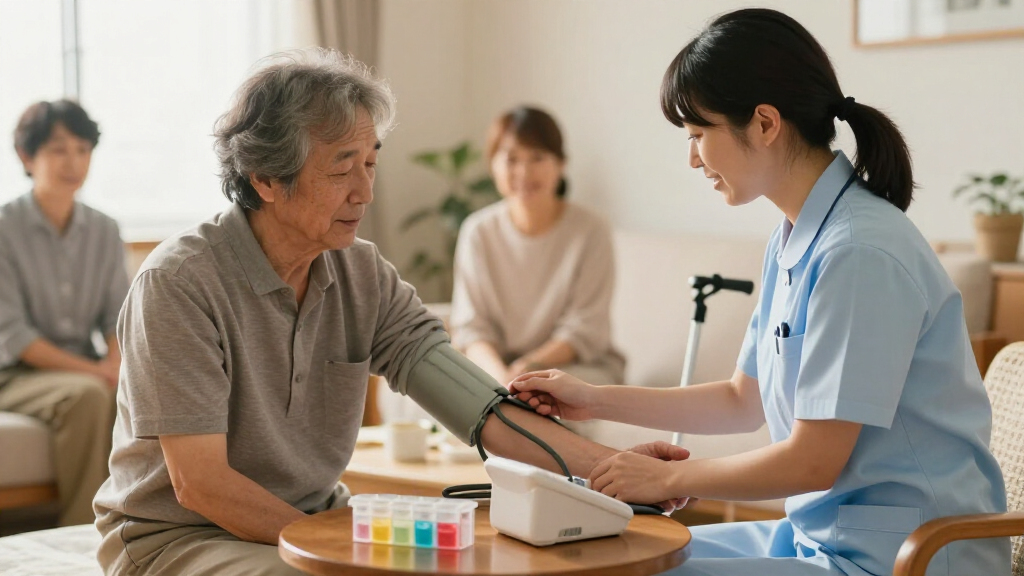
Japan’s aging population means more older adults are receiving medical care at home, according to the report. This physician-led service involves regular visits for people who have difficulty attending clinics or hospitals. Despite multimorbidity being common in this setting, the researchers noted that few studies had assessed its prevalence among home-care patients.
The team, led by researchers at the University of Tsukuba, examined records from medical facilities in Tokyo and Ibaraki Prefecture. The paper, by Gen Nakayama and colleagues, was published in the Journal of General and Family Medicine in 2026. It is titled “Multimorbidity Among Patients Receiving Home Care in Japan: Prevalence, Levels, and Association With Emergency Home Visits,” DOI 10.1002/jgf2.70170.
In this study, multimorbidity means having two or more chronic conditions. The researchers also considered the number of conditions in categories, including two or three, four or five, and six or more, to examine how condition burden related to emergency home visits.
“A simple count of chronic conditions may help health care professionals identify home care patients at increased risk of sudden health deterioration who may benefit from more proactive care planning.”
— The study authors, as summarized in the report
As an affiliate, we earn on qualifying purchases.
Limits of the Available Findings
The available report does not state the patients’ average age, recruitment dates, or detailed demographic profile, nor does it describe how the participating facilities or patients were selected. Without those details, it is difficult to judge how closely the 506-person group reflects the broader population receiving home care in Japan.
The report also does not provide absolute emergency-visit rates for each condition-count group, the size of the statistical effects, or information about other factors that might influence visits. It is therefore unclear how much a condition count adds to risk assessment beyond a patient’s overall health and care circumstances. The study’s reported association does not establish cause and effect.
In addition, the outcome covered one month, and the report does not say whether the researchers assessed other urgent-care outcomes or followed patients over a longer period. Further details from the full study would be needed to assess its methods and the wider applicability of its results.
emergency alert systems for elderly at home
As an affiliate, we earn on qualifying purchases.
As an affiliate, we earn on qualifying purchases.
How Care Teams Could Apply the Results
The study suggests that clinicians could consider a patient’s chronic-condition count when planning home care, while using it alongside individual clinical assessments rather than as a stand-alone prediction. The report does not announce a new care program or change in Japanese policy based on the findings.
Further research could test whether the association holds across a wider range of regions and home-care settings, and whether condition counts improve existing assessments of patients’ needs. Studies that report group-specific visit rates and examine care interventions would help show whether more proactive planning changes outcomes. No follow-up study or policy timeline is specified in the report.
chronic condition tracking devices
As an affiliate, we earn on qualifying purchases.
As an affiliate, we earn on qualifying purchases.
Key Questions
What does multimorbidity mean in this study?
It means having two or more chronic conditions. The researchers also compared patients by the number of conditions they had.
How many patients were included?
The study included 506 adults receiving physician-led home care through medical facilities in Tokyo and Ibaraki Prefecture.
How common was multimorbidity among participants?
94.7% had at least two chronic conditions, and 57.1% had four or more. These figures describe the study participants, not necessarily every home-care patient in Japan.
What was the link with emergency home visits?
Overall, 13.2% had at least one emergency home visit in the previous month. Patients with four or five conditions, and particularly those with six or more, were significantly more likely to require a visit than those with two or three. The report does not give the size of that difference.
Does the study show that more chronic conditions cause emergency visits?
No. It reports an association between higher condition counts and emergency home visits. The findings do not establish that multimorbidity caused the visits or that a particular care plan would prevent them.
Source: rss
Cold & flu season Picks
humidifiers
As an affiliate, we earn on qualifying purchases.