
TL;DR

Turn quiet afternoons into listening time
- Thousands of audiobooks, podcasts and originals
- Listen on your phone, tablet or Echo — also offline
- Cancel anytime
A Fit&Well report describes heel lift during a squat as potentially related to limited ankle dorsiflexion, but says hip mobility or strength can also play a role. It outlines three scaled squat exercises: suspension-trainer squats, slow sit-to-stands and supported heel-elevated squat holds.
A Fit&Well report outlines three scaled squat exercises for people whose heels lift during a squat, while cautioning that the issue may not come from the ankles or calves alone. The report says limited ankle movement is one possible factor, but hip mobility and strength may also affect how someone moves into a deep squat.
The report describes limited ankle dorsiflexion—the shin’s ability to move forward over the foot—as a common explanation for heels rising during a squat. Tight calves or restricted ankle joints can limit that movement, according to the article. It also says that for some people, particularly those with weak or tight hips, heel lift may function as a protective response. The article does not establish a diagnosis for any individual reader.
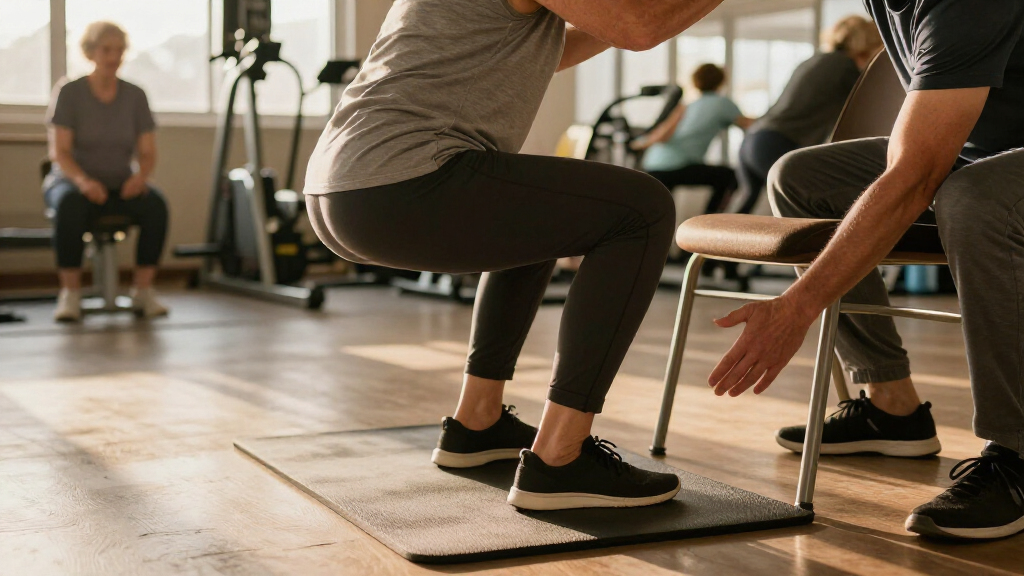
Its three suggested regressions are a suspension-trainer squat, a slow chair sit-to-stand and a deep squat hold with supported, elevated heels. The first uses straps for balance support; the second emphasizes a controlled descent and rise without using the hands; the third uses thin plates or wedges under the heels to make a deep position more accessible.
Fit&Well recommends practicing the movements gradually rather than focusing on repetitions at first. Once technique feels comfortable, it suggests three sets of each exercise, working for one minute and resting for one minute. These are the article’s recommendations, not a personalized exercise prescription.
Why Squat Heel Lift Matters
Heel lift can make a squat feel difficult or unstable and may signal that a person’s available movement range does not match the depth they are attempting. The report’s practical point is that repeatedly stretching the calves may not address every cause: ankle movement is one possibility, while hip mobility or strength may also be involved.
That distinction matters because the suggested exercises change the task rather than insisting on a full, unsupported squat straight away. Straps, a chair or heel support can let a person practice a controlled range and build capacity over time. The article does not claim that the drills will work for everyone, or that heel lift necessarily indicates an injury.
Products Worth Considering

Solo Stove Bonfire 2.0 Smokeless Wood-Burning Fire Pit with Stand, Silver

Solo Stove Ranger 2.0 15-Inch Smokeless Fire Pit with Stand

Husqvarna Power Axe 350i 18-Inch Cordless Chainsaw Kit
As an affiliate, we earn on qualifying purchases.
How the Three Squat Regressions Work
The Fit&Well article frames the exercises as regressions of an unweighted squat: simpler or supported versions that allow someone to practice parts of the movement. It says regular practice over a few weeks may improve strength through different phases of the squat, though it provides no study data or measured outcomes to quantify that effect.
In a suspension-trainer squat, the person holds the straps and leans back while bending the knees, using support to work toward a deeper position. The chair sit-to-stand prioritizes control: stand without pushing off with the hands, then lower slowly to the seat. For the supported hold, the person squats with heels on plates or wedges and can reduce their height over time, working toward a flat-footed position if able.
The source advises keeping the knees wide enough to make room at the hips and maintaining a flat back during the supported hold. It also describes progressing the strap exercise by relying less on the trainer. These are technique notes from the report, not confirmation that a particular form or depth is suitable for every person.
What Heel Lift Cannot Diagnose
The report does not identify a single cause for heel lift or provide an assessment method to distinguish ankle restriction from hip-related factors. It also does not cite research findings, report participant outcomes or specify how much improvement readers should expect. Its suggestions should be understood as general exercise guidance rather than proof of a cause or a guaranteed fix.
Whether the exercises are appropriate can depend on a person’s pain, injury history, balance and mobility. The source does not give advice for people who experience pain while squatting. Anyone with pain, a recent injury or concern about movement should seek guidance from a qualified health or exercise professional before changing their training.
Progress Gradually With Support
The next step in the report’s approach is to practice the variations at a manageable depth and focus on controlled movement. It suggests progressing by reducing reliance on suspension straps, slowing the sit-to-stand descent, and lowering the heel support gradually. The stated goal is to build toward a squat with heels on the floor, but the article does not set a deadline or say that every reader will reach that position.
Readers should treat improvement as individual rather than judge it by a fixed number of repetitions. The source offers no follow-up data on the exercises, so it remains unclear how often they resolve heel lift or which variation works best for different causes.
Key Questions
Why do my heels come up when I squat?
Fit&Well says limited ankle dorsiflexion, sometimes associated with tight calves or restricted ankle joints, is one possible reason. It also notes that hip mobility or strength may play a role for some people. The article does not establish the cause for any individual.
What three exercises does the report suggest?
It describes a suspension-trainer squat, a slow sit-to-stand from a chair and a deep squat hold with the heels supported on plates or wedges. They are presented as scaled ways to practice squat movement and control.
Should I stretch my calves to keep my heels down?
The report says calf and ankle tightness can be factors, but that stretching alone may not address hip-related limits. It does not offer a personalized assessment or say that calf stretching is necessary for everyone.
How often should I do the exercises?
Fit&Well suggests beginning by practicing each version and exploring range gradually. Once technique feels comfortable, it proposes three sets per exercise, working for one minute and resting for one minute. This is general guidance from the article, not an individualized plan.
Source: fitandwell.com