TL;DR

Turn quiet afternoons into listening time
- Thousands of audiobooks, podcasts and originals
- Listen on your phone, tablet or Echo — also offline
- Cancel anytime
Choose utensils by matching grip size, texture, weight, and shape to the hand and the task. Try a few options with familiar foods, check comfort after several minutes, and prioritize a secure, easy-to-clean grip that supports your preferred way of eating.
A slim spoon can feel as awkward in your hand as a pencil when your fingers are tired. A thicker, nonslip handle may make the same bowl of oatmeal easier to scoop, but no single design suits every hand or every meal.
This guide explains how to choose utensils with comfortable, easy grips by comparing handle size, texture, weight, and shape. You will also learn how to try a utensil at home, what to check before buying, and when a professional can help you find a better fit.
The goal is simple: make everyday meals feel more manageable without turning the kitchen into a clinic. Your favorite fork should still feel like yours—just easier to hold when you need it.
Identify the difficult movement—gripping, scooping, cutting, wrist motion, steadiness, or fatigue—before choosing a utensil.
Try a thicker handle if a narrow one requires a tight pinch, but avoid a grip so large that it limits control.
Compare texture and weight with familiar foods, then check how the utensil feels after several minutes.
Choose angled or flexible designs only when they make your usual eating motion feel more natural.
Check that sleeves fit securely and clean properly; ask a qualified professional for help when eating remains difficult or unsafe.
Start with the hand problem you want to solve
Choosing utensils with comfortable, easy grips starts with naming the moment that feels difficult: holding the handle, scooping food, turning your wrist, or keeping a bite steady. A clear problem points you toward a useful feature, while shopping by appearance alone can leave you with a drawer full of tools that do not help.
Think about an ordinary breakfast. If your fingers tire while holding a slim-handled teaspoon, a thicker grip may be worth trying; if you can hold the spoon but struggle to bring it to your mouth, an angled design may be more relevant. These are different challenges, so they call for different experiments.
People with arthritis, reduced hand strength, tremors, limited dexterity, or a temporary injury may appreciate easier grips, but their needs vary. Someone with sore finger joints may prefer a soft, broad handle, while another person may want a light, narrow one that feels familiar. Personal comfort matters, and an assistive-looking utensil is not automatically better.
For a week, notice which everyday tasks take extra effort. Does a fork slip when your hands are damp? Does cutting a piece of chicken tire your hand more than eating soup? Write down the task and the troublesome movement. That small note gives you a practical starting point instead of a vague search for “something easier.”
Products Worth Considering

Greenworks 40V Cordless Leaf Blower/Vacuum with 5.0 Ah Battery and Charger

Solo Stove Ranger 2.0 15-Inch Smokeless Fire Pit with Stand

DGSL Twin-Wall Polycarbonate Greenhouse Panels, 24 Pack, 4 × 2 ft
As an affiliate, we earn on qualifying purchases.
Find a handle size that feels secure, not bulky
Choosing utensils with comfortable, easy grips often means comparing handle thickness first: a broader handle may need less pinching force, but an oversized grip can make the utensil difficult to guide. The best size lets you hold on without squeezing hard and move the spoon or fork with control.
A slim metal handle can make the fingers curl tightly around a narrow surface. A built-up handle spreads contact across more of the hand, a little like holding a thick garden trowel instead of a thin wire. That broader contact may feel kinder during a long meal, especially when the hand tires quickly.
Still, bigger is not always better. If a grip fills your palm so completely that your fingers cannot settle around it, the utensil may wobble or feel clumsy. Imagine lifting a pea from a plate: a handle that feels comfortable while resting in your palm must also let you steer the fork tip accurately.
Try different sizes with a few familiar tasks before you choose a set. Hold each handle for several minutes, then scoop applesauce, spear a soft piece of fruit, or stir tea. Comfort after repeated movement tells you more than a quick squeeze in a shop. If you are choosing utensils with a family member, let that person lead the trial and describe what feels natural.
Choose a grip texture that stays comfortable through a meal
A comfortable grip needs enough traction to stay put without feeling sticky, rough, or irritating against the skin. Soft, nonslip materials can help when a smooth metal handle slips in damp hands, but the surface should still feel pleasant and be practical to clean.
Picture carrying a mug from the counter after washing vegetables: your fingers may be slightly damp, and a polished handle can feel slick. A textured or rubbery grip may provide a steadier hold. For someone whose hands are dry or sensitive, though, a coarse texture might rub or catch on the skin.
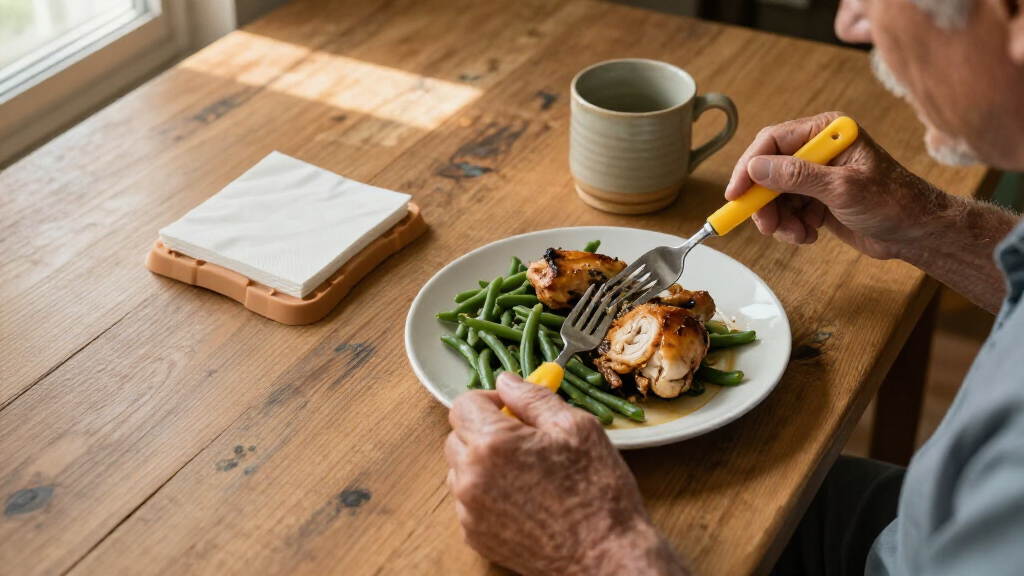
Grip sleeves can add thickness to ordinary utensils, which may be a simple way to try a broader handle without replacing everything in the drawer. Check that a sleeve fits securely and follow its care instructions. A loose cover can shift while you eat, and a cracked or deteriorating one should not stay in daily use.
Cleaning deserves a place in the decision. Look for clear instructions about dishwasher use and whether the grip comes off for washing. A removable sleeve may make cleaning easier, but only if it is simple to remove, dry, and put back on. Secure fit and easy care are a better pair than a soft surface that becomes a nuisance after supper.
Balance weight against steadiness and hand fatigue
Choosing utensils with comfortable, easy grips also means noticing how the utensil’s weight feels in motion: a light utensil can take less effort to lift, while a heavier one may feel steadier to some people. Neither option wins for everyone, because balance, hand strength, and the kind of food all matter.
For example, a lightweight spoon may suit someone whose hand tires while carrying each bite from a bowl. Another person who experiences unsteady movements may prefer a little more weight because it feels easier to guide. Yet that same weight can become tiring over a long meal or make a full spoon harder to lift.
Weight distribution matters as much as the number on a package. If a heavy handle pulls the utensil backward, or a large spoon bowl makes it tip forward, the tool may feel awkward even when its total weight seems reasonable. Try it with food, not just in your hand: a spoonful of thick soup tells a different story from an empty utensil.
Test for several minutes, then notice whether your fingers, wrist, or forearm feel more tired. A brief trial can miss the slow fatigue that appears halfway through lunch. Steadiness should not come at the cost of comfort, and a light utensil is not automatically easier if you cannot control its movement.
Match the utensil shape to the food and wrist movement
Choosing utensils with comfortable, easy grips means matching the shape to the movement you want to make: a spoon for scooping, a fork for spearing, or an angled handle when wrist movement feels restricted. Curved, angled, swivel, and flexible designs can help some people, but they are not universally easier to use.
A straight-handled spoon may feel familiar for cereal, while an angled spoon may make it easier for someone to reach a bowl without turning the wrist as much. A fork that holds food securely may be more useful at dinner than a spoon designed for soup. The right choice follows the meal, not a promise printed on packaging.
Consider how you sit at the table, too. A utensil that works while you sit upright in your favorite chair may feel different at a low kitchen table or when the plate is far away. If an angled handle makes your wrist feel relaxed but causes the spoon bowl to tilt awkwardly, it may not suit your reach or posture.
Try one change at a time with a familiar food. Use your usual spoon for a bowl of yogurt, then try an angled one and notice whether the path from bowl to mouth feels easier to control. Less wrist movement is useful only when the whole motion feels natural; if the design makes eating clumsy, return to a simpler shape.
Use this five-step home trial before buying a set
A short home trial can show whether a grip works better than a quick look at the handle. Test a few utensils with familiar foods, in your usual seat, and long enough to notice comfort and control; then choose only the features that help in daily use.
- Name the hard task. Decide whether the trouble is gripping, scooping, cutting, wrist movement, steadiness, or fatigue. For instance, difficulty cutting toast calls for a different test than difficulty lifting soup.
- Choose a small comparison. Try two or three options, such as a standard handle, a thicker grip, and a textured sleeve. A small set makes the differences easier to notice.
- Use familiar food. Scoop oatmeal, spear banana, or cut a soft sandwich. Food gives you a more realistic test than waving an empty utensil in the air.
- Keep going for several minutes. Check how the grip feels after repeated bites. Ask whether it slips, pinches, strains your wrist, or feels too bulky.
- Check care and storage. Read the cleaning instructions and make sure the utensil fits your dishwasher or drawer routine.
Suppose your father finds that a broad spoon helps with yogurt but feels clumsy with peas. That does not mean the trial failed; it shows he may want different utensils for different foods. One useful adjustment at a time keeps the process calm and helps you avoid buying a full matching set before you know what works.
Check safety, cleaning, and when to ask for help
A grip should stay firmly attached, feel comfortable, and clean according to its care instructions. Check regularly for loose sleeves, cracks, or worn surfaces; a damaged grip can shift during a bite and turn a helpful tool into a distraction.
Food-contact materials and cleaning instructions matter in a busy kitchen. If a sleeve comes off, wash and dry it as the manufacturer directs before replacing it. If it cannot be cleaned easily or begins to break down, stop using it and look for a better-maintained option.
Utensils can make eating safer and less tiring for some people, especially for people with hand weakness, tremors, reduced dexterity, or temporary injuries. But a better grip does not address every concern. If eating remains persistently difficult, painful, exhausting, or unsafe—or if swallowing or frequent choking worries you—speak with an appropriate qualified professional.
An occupational therapist can assess how you hold and use utensils during everyday tasks and help you explore options. That guidance can be particularly useful when several features seem possible, or when a utensil that helps one movement makes another harder. Ask for individualized help when routine meals remain a struggle; your independence and preferences belong at the center of the decision.
Frequently Asked Questions
What kind of utensil is easiest to hold?
A utensil with a comfortable, nonslip handle is a sensible starting point, and a thicker grip may help if a slim handle makes you pinch tightly. The best fit depends on your hand, the task, and what feels controlled after several minutes of use.
Are weighted utensils helpful for tremors?
Some people find a weighted utensil steadier, while others find the extra weight tiring or hard to lift. Try one with a familiar food before deciding, and pay attention to comfort throughout the meal rather than only the first few bites.
Do built-up handles help with arthritis?
A broader handle may reduce the need for a tight pinch and feel easier to hold for some people with sore or stiff fingers. Comfort varies, so choose a size that does not force your hand into an awkward position or make the utensil difficult to guide.
Can I make regular utensils easier to grip?
Grip sleeves can add thickness or traction to an ordinary spoon or fork. Check that the sleeve fits securely, feels comfortable, and can be cleaned according to its care instructions; replace it if it becomes loose, cracked, or worn.
Are angled utensils always better for limited wrist movement?
No. An angled or flexible utensil may reduce wrist movement for some people, but it can feel unfamiliar or make food harder to control for others. Try the design with a usual meal and keep it only if the whole movement feels natural.
When should I ask a professional about eating utensils?
Ask an appropriate qualified professional if eating remains difficult, painful, exhausting, or unsafe, or if you have concerns about swallowing or frequent choking. An occupational therapist can assess daily utensil use and help you explore options suited to your needs.
Conclusion
Choose the utensil that makes your familiar meal feel easier, not the one with the most features. Try a few handle sizes, textures, and weights with the foods you actually eat, then keep the option that feels secure without tiring your hand.
A good grip should disappear into the rhythm of supper: the spoon in your hand, the warm bowl on the table, and the pleasure of eating at your own pace.