
TL;DR

Turn quiet afternoons into listening time
- Thousands of audiobooks, podcasts and originals
- Listen on your phone, tablet or Echo — also offline
- Cancel anytime
For a country home, choose flooring by room: vinyl or porcelain tile can suit muddy entries and spill-prone kitchens, while bedrooms and sitting rooms may call for warmer, softer surfaces. Mid-tone colors, tight seams, entrance mats, and prompt spill cleanup make routine care easier, but product water-resistance claims, subfloor needs, comfort, and repair options all affect how well a floor serves you.
A pair of muddy boots can turn a tidy entry into a map of the garden before the kettle has boiled. In a country home, grit, damp coats, paw prints, and busy visitors are part of daily life, and they all affect how flooring looks and wears.
Choosing easy-clean flooring does not mean giving every room the same hard, cold surface. You can make a practical choice for the kitchen and back door while keeping a bedroom or sitting room warm underfoot. The right balance depends on the room, your home’s subfloor, comfort, and the kind of cleaning you want to do.
This guide walks you through common flooring choices, what to check before buying, and simple habits that help floors last. You’ll also see why a waterproof label deserves a closer look—and why a mid-tone floor can be kinder to your eyes and your broom than a very dark, glossy one.
Use vinyl or tile as candidates for muddy entries and spill-prone rooms, then check each product’s fitting instructions and care limits.
Mid-tone colors, subtle patterns, and low-gloss finishes often disguise everyday dust and small marks better than very dark, pale, glossy surfaces.
Treat “water-resistant” as a specific product claim: water can still reach joints, edges, or the subfloor.
Have an uneven or moisture-prone old-house subfloor assessed before choosing a floor that needs a stable, flat base.
Catch grit at the door, clean spills promptly, and use only cleaning methods approved for your flooring.
Choosing Easy-Clean Flooring for a Country Home
Match each room’s floor to its daily mess, comfort needs, and the building beneath it. Practical choices can keep busy spaces easier to clean without making every room feel hard and cold.
Match the floor to the room
Start with where water lands, grit collects, and comfort matters most.
- Vinyl or tile may suit entries, kitchens, and utility rooms.
- Fewer seams can make spills and crumbs easier to clear.
- Tile grout still needs attention.
- Carpet can add warmth in bedrooms.
- A hard floor with a washable rug keeps sweeping simple.
- Living rooms can balance warmth and easy movement.
Compare common choices
The right material depends on the room, installation, and care you are prepared to give it.
| Flooring | May suit | Check before buying |
|---|---|---|
| Sheet vinyl | Utility rooms and spill-prone spaces | Sharp objects and heavy loads |
| Vinyl plank or tile | Kitchens, entries, and busy areas | Wear layer, seams, warranty, and fitting |
| Porcelain or ceramic tile | Kitchens, bathrooms, and entries | Grout care, warmth, and slip suitability |
| Laminate or engineered wood | Rooms where a wood-like look matters | Moisture limits and cleaning guidance |
| Sealed concrete or stone | Rooms suited to a hard surface | Finish, sealing, temperature, and cracks |
| Carpet | Lower-traffic, comfort-first rooms | Mud, food, and pet cleanup |
Choose a forgiving finish
Color, sheen, texture, and seams affect how everyday mess looks and cleans up.
Try mid-tones
Gentle variation can disguise dust, paw prints, and small marks better than very dark or very pale surfaces.
Keep glare in mind
Matte or low-gloss finishes can make everyday marks less noticeable than glossy ones.
Balance grip and grit
Texture may help with grip, while deeply rough surfaces can hold onto dirt.
Check the joints
Fewer seams and grout lines can simplify cleaning, but installation quality matters.
Check the floor beneath
An older home’s subfloor and moisture conditions can rule out a product that otherwise seems suitable.
Check whether the subfloor is uneven, suspended timber, or moisture-prone.
Read fitting instructions, care guidance, warranty terms, and water-resistance limits.
Ask about sealing, refinishing, and how a damaged plank, tile, or section can be replaced.
Make routine care easier
Small habits help a busy country home’s floors stay welcoming.
- Catch grit at the door with an entrance mat or boot tray.
- Sweep or vacuum regularly and clean spills promptly.
- Use only cleaning methods approved for the flooring.
- Check suitability and slip resistance where rainwater lands.
Start With the Room, Not the Flooring Sample
Easy-clean flooring for a country home starts with the room’s daily job: wet, busy spaces need surfaces that handle spills and grit, while quieter rooms can put more weight on warmth and comfort. Match the material to the mess you expect there, then check that it suits the building beneath it.
At the back door, garden soil and rainwater come in on boots, so sheet vinyl, suitable vinyl plank, or tile may be easier to wipe than carpet or wood. In a kitchen, splashes gather near the sink and cooker. A floor with few seams can make crumbs and spills simpler to sweep up, though tile grout still needs attention.
A bedroom has a different rhythm. You might prefer carpet beside the bed for a softer first step in the morning, or a hard floor with a washable rug if you want to keep sweeping simple. A sitting room may need to balance a favourite chair, a warm fire, and comfortable movement across the floor.
Consider an older farmhouse with a utility room beside the garden. If the dog comes in there after a wet walk, a wipeable surface and a boot tray can keep damp paw marks from reaching the hallway. The same floor may feel too hard in a bedroom. One home can sensibly use several materials; consistency matters less than a good fit for each space.
Before you choose, note where water lands, where grit collects, and which rooms you use most. Then consider how easy cleaning for the floor will be alongside its comfort and appearance. That short walk through your own routines tells you more than a small sample held under showroom lights.
Products Worth Considering

Traeger Ranger Portable Wood Pellet Grill and Smoker with Cast Iron Griddle

Traeger Trailhead Portable Wood Pellet Grill and Smoker with Cover and Inverter

Husqvarna ST224 Two-Stage Gas Snow Blower, 24-Inch, 212 cc
As an affiliate, we earn on qualifying purchases.
Compare the Floors That Handle Country Mess Best
Vinyl and porcelain or ceramic tile often suit spill-prone rooms because you can wipe their surfaces clean, but neither removes every maintenance concern. Vinyl offers a smoother, less grout-heavy surface, while tile brings a durable, hard finish that can be cold underfoot and needs grout care. The best pick depends on your room and installation.
Sheet vinyl has fewer seams than plank flooring, which can be useful in a utility room where water and muddy shoes are routine. Vinyl planks and tiles come in wood- or stone-like designs, but check the product’s wear layer, warranty, and fitting requirements. Water may still cause trouble where it reaches an edge or passes under some installations.
Tile is easy to wipe after a splash, but its grout lines can gather dirt. A pale grout may show marks more clearly than a darker one. For example, a busy kitchen leading to a garden might benefit from a tile finish you can clean without the room feeling too polished or slippery when damp. Ask about the finish’s suitability for that use.
Wood-based floors need more care around standing water. Engineered wood has a real-wood surface and layered construction, while laminate can mimic wood with a hard surface that is generally easy to sweep. Traditional laminate may swell if water gets into its joints; newer products vary, so verify the specific product’s limits instead of assuming the category is waterproof.
Sealed concrete or stone can be tough and straightforward to maintain when properly finished. Porous stone may need sealing, and concrete can feel cold or develop cracks. Carpet gives a bedroom warmth, but mud, food, and pet accidents demand more work. Think of each material as a different pair of wellies: useful in the right conditions, awkward in the wrong ones.
| Flooring | Where it may fit | What to check |
|---|---|---|
| Sheet vinyl | Utility rooms and spill-prone spaces | Damage from sharp objects or heavy loads |
| Vinyl plank or tile | Kitchens, entries, and other busy areas | Wear layer, warranty, seams, and installation |
| Porcelain or ceramic tile | Kitchens, bathrooms, and entries | Grout care, warmth, and suitable slip resistance |
| Laminate or engineered wood | Rooms where wood-like appearance matters | Moisture limits and manufacturer’s cleaning guidance |
| Sealed concrete or stone | Rooms where a hard, durable surface suits the home | Finish, sealing needs, temperature, and cracks |
This table is a starting point, not a guarantee. Specific products and installation details vary, so read the care instructions and warranty before buying.
Choose a Finish That Hides the Everyday Dust
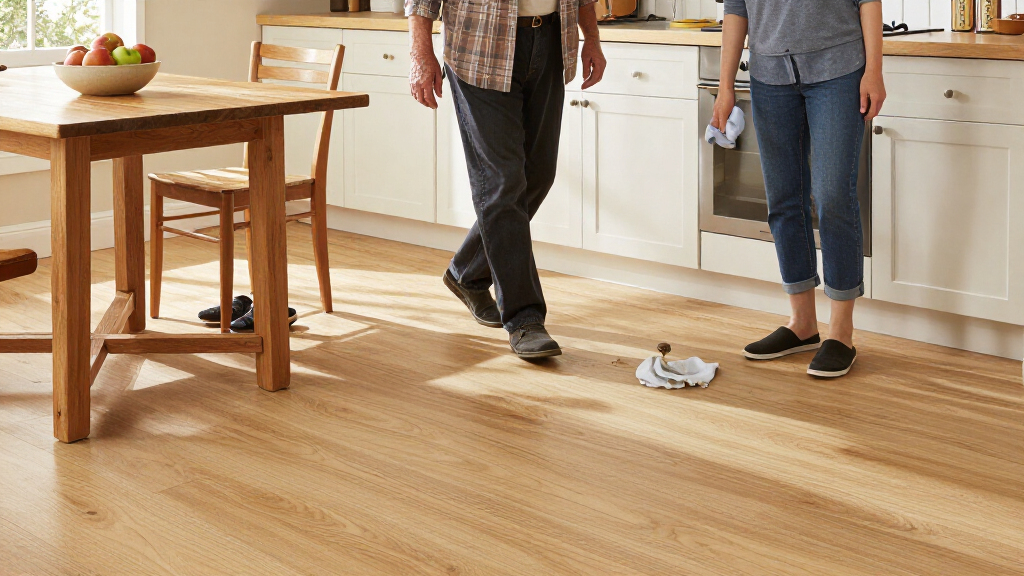
A mid-tone floor with a little natural variation often hides everyday dust, paw prints, and small marks better than a very dark or very pale glossy surface. Matte finishes and subtle patterns can make routine mess less noticeable, which may mean your floor looks settled between cleanings instead of asking for attention after every trip outside.
Imagine a charcoal floor just inside the back door. Fine pale dust and crumbs stand out against it, and polished patches catch the afternoon sun. A very light, plain floor can show dark garden soil just as clearly. Warm oak-like tones, gentle stone variation, or a quiet pattern can soften that contrast.
Texture calls for a little judgement. A lightly textured surface may help with grip, depending on the material and how it is used, while a deeply rough finish can hold onto grit. If the floor is for an area where rainwater lands, ask the retailer or manufacturer for information about its suitability and slip resistance in those conditions.
Wide planks can reduce the number of visible joints compared with narrow ones, but the result depends on the product and quality of installation. Fewer lines can make sweeping feel simpler; they do not make water harmless if it gets into the joints. Visual calm and easy upkeep can work together, but no finish hides every spill or replaces cleaning.
Take samples home if you can and view them beside your own doors and windows. In the morning, a warm brown may look soft and welcoming; by a sunny afternoon, a glossy surface may show every paw print. The floor should suit your actual light, furniture, and daily traffic—not just the bright showroom.
Check the Water Claim Before You Bring a Sample Home
“Water-resistant” usually means a floor can tolerate some surface spills for a limited time, not that water can never damage it. Joints, edges, transitions, and the subfloor still matter. A product’s water label does not tell you by itself what happens after a leak, a long puddle, or water that slips beneath the floor.
Suppose a kitchen tap drips unnoticed over the weekend. A surface may look intact while water finds a seam or an unsealed edge. With some installations, that moisture can affect what lies underneath. This is why a headline claim is less helpful than the manufacturer’s detailed specifications and warranty exclusions.
Before you buy, read the cleaning instructions and ask what the warranty covers, how quickly you must wipe spills, and whether the floor can go in your particular room. Ask about joints around doorways, cabinets, and appliances too. If an installer explains a moisture barrier or a particular fitting method, make sure you understand what it does and whether the product instructions require it.
Wood and laminate need special attention around prolonged moisture. Engineered wood is generally more dimensionally stable than solid wood, but standing water remains a risk. Traditional laminate can swell when water enters its joints, and improved water resistance in newer products does not make every laminate floor suitable for wet conditions.
In a farmhouse kitchen, a mat by the sink and a quick wipe after a spill can help protect a suitable floor. They cannot change the product’s limits. Choose a surface that fits the expected moisture, and remember that the floor covering is only one part of the system beneath your feet.
Keep Comfort and the Old House in the Same Plan
Hard floors are often easy to sweep, but they can feel cold and unforgiving; an older or uneven subfloor can also rule out some products or fitting methods. Check the base of the floor as well as its surface, and think about how the room feels when you stand, sit, and walk through it in ordinary shoes or slippers.
Older country homes may have suspended timber floors, uneven boards, or areas prone to moisture. A floor that needs a flat, stable base may not be a straightforward fit until the subfloor has been assessed and prepared. Movement or damp beneath the finish can affect how the new floor performs, whatever its showroom appearance.
Consider a cool tiled kitchen where you spend a long time preparing meals. A washable mat in a suitable place may add a softer step, as long as it lies flat and does not create a tripping edge. In a sitting room, a rug can bring warmth over a hard floor, while carpet may suit a quiet bedroom where mud and spills are less common.
Grip also deserves a place in the choice. A very smooth, glossy surface can feel different underfoot from a lightly textured finish, especially where water may land. Ask for product information for the room’s intended use; avoid assuming that “textured” alone tells you how a floor will behave when wet.
Before work begins, have a qualified flooring installer or suitable building professional assess a visibly uneven or moisture-prone base. Fixing the underlying problem first may protect your investment and help the finished room feel more comfortable. A proper assessment is particularly helpful when the house has old boards or a history of damp.
Use a Simple Routine to Keep Floors Looking Welcoming
Regular sweeping or vacuuming, prompt spill cleanup, and a cleaner approved for your flooring handle much of the routine care in a busy country home. Small habits keep grit from scratching surfaces and stop wet dirt from being tracked from the entry to the kitchen. A little attention at the door can spare you a longer cleanup later.
- Catch dirt at the entrance. Place a suitable mat by the door and keep a boot tray nearby. On a wet afternoon, ask visitors to leave muddy boots there before they cross the hall.
- Pick up grit regularly. Sweep or vacuum using a setting and attachment suited to the floor. Garden grit dragged under shoes can scratch some surfaces over time.
- Wipe spills promptly. Use a soft cloth and follow the product’s cleaning instructions. Avoid soaking the floor while tackling a small puddle.
- Protect busy spots. Fit furniture pads to chair and table legs. If you use rugs, choose ones that lie securely and suit the flooring underneath.
- Plan for the material. Include grout care for tile, sealing where recommended, and refinishing if the floor requires it. Find out how to replace a damaged plank, tile, or section before a repair is needed.
Steam cleaners may not suit every floor, and cleaners that work well on tile can harm other finishes. Follow the manufacturer’s guidance rather than reaching for the strongest product in the cupboard. If you keep a note of the flooring type and its cleaning instructions, you will not need to guess when a spill happens.
A washable entry mat, a broom near the back door, and a handful of felt pads are humble helpers. They will not make maintenance disappear, but they can make care feel manageable. A good routine fits into your day, like hanging a coat to dry instead of letting it drip across the hall.
Make a Shortlist You Can Live With for Years
A good flooring shortlist weighs appearance, cleaning, comfort, moisture, and repairs together, because the best-looking option on day one may demand more care than you want. Write down your must-haves before visiting a showroom so a pretty sample does not distract you from the room’s real needs.
Start with three questions: Where does dirt enter? Where might water sit? How much upkeep feels reasonable? A retired gardener who uses the back door daily may prioritize an easy-to-wipe entry and a finish that disguises soil. Someone who mostly entertains in the sitting room may value warmth and the look of wood more heavily there.
Then ask about repair. If a heavy pot chips a tile or a chair catches a plank, can you replace one piece, or would the whole area need attention? Keep any spare material and product details in a safe place. That small bit of planning can make a later repair less of a treasure hunt.
Newer flooring ranges may advertise recycled content or lower emissions, but environmental claims are not uniform. Look for clear information about materials, indoor-air-quality certifications, durability, and disposal at the end of the floor’s life. Availability and standards vary by market, so compare what the manufacturer actually states.
Try this simple order: choose the room’s needs, check the subfloor, compare care requirements, then judge color and texture. If two options are close, the one with clearer instructions, a repair path, and a finish that suits your light may be easier to live with than the one that merely promises a perfect look.
Frequently Asked Questions
What flooring is easiest to clean in a country home?
There is no single best choice for every room. Vinyl and porcelain tile are common candidates for spill-prone spaces, while the right choice depends on moisture, traffic, comfort, installation, and the subfloor.
Which flooring works well with muddy boots and pets?
A durable, water-tolerant surface with a finish that disguises marks can be practical near a garden entrance. Pair it with a boot tray and washable mat, and sweep grit regularly to help reduce scratches.
Is waterproof flooring completely waterproof?
Not necessarily. A product’s surface may resist water while joints, edges, transitions, or the subfloor remain vulnerable. Read the manufacturer’s specifications and warranty to learn what the claim covers and how quickly spills should be cleaned.
Is vinyl or laminate easier to maintain?
Both are generally straightforward to sweep and damp clean using approved methods. Vinyl is often more tolerant of moisture, while laminate’s water resistance varies by product and installation, so check the specific limits before choosing it for a busy or wet area.
Can wood flooring work in a kitchen or entryway?
It can, provided the product suits the room and you clean spills promptly. Engineered wood can be more dimensionally stable than solid wood, but wood-based flooring remains less forgiving of prolonged moisture than tile or many vinyl products.
How can I keep tile grout clean?
Sweep regularly, use a suitable cleaner, and seal grout if the product instructions recommend it. Grout can collect dirt, and lighter colors may show stains more clearly, so include grout care in your maintenance plan.
What should I do about an uneven floor in an old house?
Have the subfloor assessed before choosing and installing a new covering. Some materials require a flat, stable base, and movement or moisture underneath can affect how the finished floor performs.
Conclusion
Choose flooring by the life of each room: a practical surface by the garden door, a comfortable one where you rest, and a careful check of the subfloor and product instructions before anything is installed. The best easy-clean floor is one you can care for without fuss and feel at home walking across.
Set out the boot tray, sweep the garden grit, and let the house keep its country character—muddy boots at the door, warm lamplight in the sitting room, and a floor that fits the way you live.