TL;DR

Turn quiet afternoons into listening time
- Thousands of audiobooks, podcasts and originals
- Listen on your phone, tablet or Echo — also offline
- Cancel anytime
Loading a walker or scooter into a car requires matching the method to the device type and vehicle height. Always prioritize safety by checking weight limits, using manufacturer-designated grip points, and securing the equipment properly for travel.
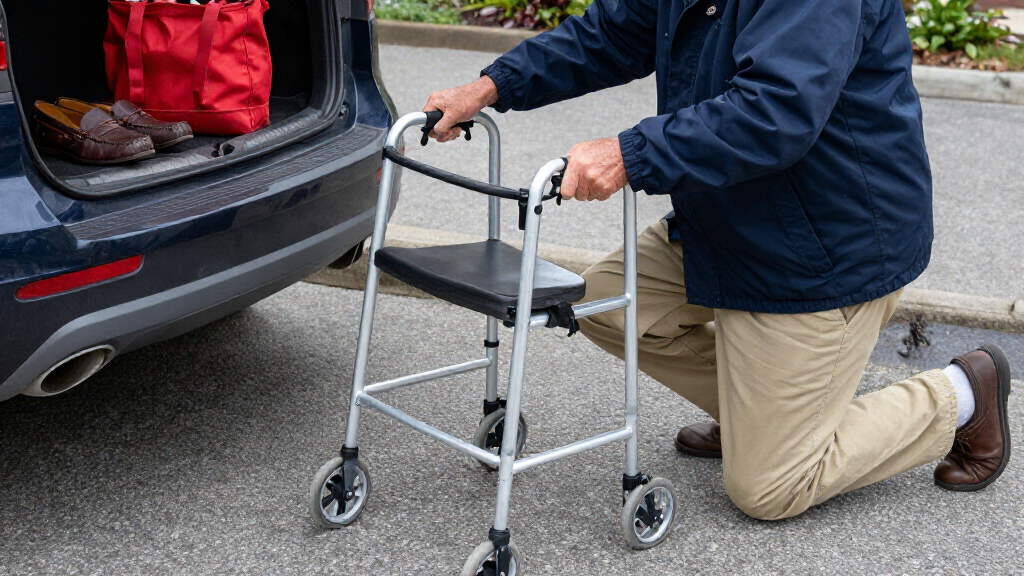
You’re standing in the driveway, the morning sun catching the chrome on your new rollator, and you’re ready for a trip to the farmers’ market. But then you look at your car. It’s a sturdy sedan, but the trunk feels like a puzzle box waiting to reject your mobility aid. Loading a walker or scooter into a car shouldn’t feel like a wrestling match with your own dignity.
Many folks worry about damaging their equipment or, worse, hurting their backs. The truth is, the right approach changes depending on whether you have a lightweight folding frame or a heavier power scooter. You don’t need to be an engineer to figure this out.
This guide walks you through practical, country-smart methods to get your gear into your vehicle safely. We’ll cover everything from simple folding techniques to when it’s time to call in a professional for a lift. Let’s get you moving with confidence.
Always check the manufacturer’s manual for folding instructions and designated grip points before lifting.
Split the load by removing scooter components like seats and batteries if permitted, to reduce lifting weight.
Use ramps or vehicle lifts for heavy scooters to avoid back strain and ensure safe transport.
Secure mobility aids with straps or nets during travel to prevent them from sliding or tipping.
Consult professionals if lifting feels unsafe or if you have chronic pain or balance issues.
Know Your Gear: Is It a Walker, Rollator, or Scooter?
Before you attempt a lift, you must understand the physics of what you’re handling. Identify the equipment first because the structural integrity and weight distribution vary wildly between a simple aluminum walker and a battery-powered scooter. A lightweight folding walker might weigh just eight to ten pounds, but its awkward, sprawling shape can make it feel heavier than a compact, dense 50-pound scooter that fits neatly in a corner.
Consult the manual not just for instructions, but for warnings. It’s your safety map. Look for specific notes on folding mechanisms and weight limits. For instance, some rollators have seats that fold up, while others have fixed frames. If you force a mechanism that isn’t designed to fold, you risk bending the frame or breaking a hinge, rendering the device useless. More importantly, ignoring weight limits on folding joints can cause sudden mechanical failure mid-lift, leading to injury.
Consider the center of gravity. A scooter with a heavy battery low in the chassis is stable but hard to tip, requiring you to lift straight up. A tall, narrow walker might be light but has a high center of gravity, making it prone to toppling sideways as you maneuver it into a tight trunk space. Knowing these details helps you plan your move before you even open the car door, preventing the awkward fumbling that often leads to strained muscles or scratched car paint.
Products Worth Considering

EGO Power+ Cordless Electric Leaf Blower, 880 CFM, with Two 4.0Ah Batteries (LB8803-2)

EGO POWER+ 21 Cordless Electric Lawn Mower Kit, Self-Propelled

Greenworks 40V 16-inch Cordless Push Lawn Mower with 4.0 Ah Battery and Charger
As an affiliate, we earn on qualifying purchases.
The Fold-and-Lift Method for Lighter Aids
For many lightweight walkers and some rollators, the fold-and-lift method is the most straightforward approach, but it requires respecting the device’s structural weak points. This works best when the device is compact enough to fit in your trunk or back seat without disassembly. Start by engaging the brakes if your device has them, so it doesn’t roll away while you’re fiddling with the hinges, which could cause you to jerk the device unexpectedly.
Fold the device exactly as the manufacturer directs. Never improvise. If there’s a latch, use it. Once folded, look for the manufacturer-designated grip points. These are usually reinforced areas on the frame, often marked with textured rubber or distinct shapes. Avoid lifting by the handles, brakes, or seat, as these parts aren’t designed to bear the full weight and can snap or slip. Lifting by non-structural parts transfers stress to components that are meant for user interaction, not load-bearing, risking catastrophic failure.
Imagine lifting a heavy cast-iron pot. You wouldn’t grab it by the handle if the handle was loose. You’d find the sturdy rim. Do the same here. Keep your back straight, bend your knees, and lift with your legs to protect your spine. If the device feels too heavy or awkward, stop. There’s no shame in asking for a hand. Pushing through discomfort is the primary cause of back injuries in home settings; recognizing the limit is a skill that preserves your long-term mobility.
Breaking Down a Scooter: Removing Components
Power scooters are often too heavy to lift as a whole unit, making component removal a critical strategy for independence. Many modern scooters are designed with this in mind, featuring quick-release seats, removable baskets, and detachable batteries. This splits the load into manageable pieces, allowing you to handle each part within your safe lifting capacity.
Check your scooter’s manual carefully. Only remove parts if the manufacturer explicitly permits it. For example, some batteries are sealed units that must stay connected to maintain warranty or safety standards, while others are modular. If you’re allowed to remove the battery, do so with dry hands and place it in a secure, upright position. Batteries contain hazardous materials and can shift, short-circuit, or cause damage if they slide around during transit. Always handle them as if they are fragile and hazardous.
Here is a quick comparison of common scooter components and their typical handling:
| Component | Typical Weight | Handling Tip |
|---|---|---|
| Seat | 15–25 lbs | Lift by the base frame, not the upholstery. Upholstery can tear, and the internal foam may compress unevenly if lifted incorrectly, affecting comfort. |
| Battery Pack | 20–40 lbs | Keep upright; avoid dropping or jarring. Terminals can short-circuit if exposed, and internal cells can be damaged by impact. |
| Front Basket | 2–5 lbs | Remove to save space; easy to lift. Check for loose items inside that could fall out and scratch the vehicle interior. |
| Chassis | 50–80+ lbs | Requires a ramp, lift, or two people. This is the structural core; attempting to lift it alone risks severe back injury or dropping the unit. |
Remember, the chassis is the heaviest part. If you can’t lift it safely, you need a different strategy, like a ramp or a vehicle lift. Attempting to bypass the chassis weight is a false economy; the cost of a medical injury far outweighs the cost of proper equipment.
Using Ramps and Lifts: When Lifting Isn’t Enough
If your scooter is too heavy to lift, or if you have limited strength, a portable ramp or vehicle lift is often the safer choice. Portable ramps are great for lower vehicles like sedans or hatchbacks. They allow you to roll the scooter up into the trunk or back seat, converting a vertical lift into a horizontal push, which is biomechanically easier on the body.
However, ramps have limits. You must check the ramp’s weight rating and the angle it creates. A steep ramp can be dangerous, causing the scooter to tip backward or requiring excessive force that strains your shoulders. Measure the height of your vehicle’s cargo floor and compare it to the ramp length. A longer ramp provides a gentler slope, which is easier on your arms and safer for the equipment. The tradeoff is storage space; longer ramps are bulkier to store in the vehicle when not in use.
For frequent transport, a vehicle-mounted lift or carrier might be worth the investment. These systems attach to the hitch or trunk and mechanically raise the scooter. According to accessibility experts, these lifts reduce the risk of back injury significantly by eliminating manual lifting entirely. A qualified installer can confirm if your vehicle can support the weight and how to use the lift correctly. While the upfront cost is higher, the long-term preservation of your physical health and vehicle integrity makes it a prudent investment for daily users.
Securing Your Mobility Aid for the Drive
Loading the device is only half the battle. You must secure everything for travel. A loose walker or scooter sliding around in the trunk can become a projectile during a sudden stop. It’s a safety hazard for you and your passengers, potentially causing injury or damaging the vehicle’s interior structure.
For walkers and rollators, use bungee cords or cargo nets to tie them down to anchor points in the trunk. Make sure they can’t tip over. For scooters, follow the manufacturer’s instructions for transport. Often, you’ll need to use ratchet straps to secure the frame to the vehicle’s floor or seat anchors. Ratchet straps provide a tighter, more consistent tension than bungees, which can loosen over time due to vibration.
Do not rely on the scooter’s parking brake alone. It’s designed for parking on flat ground, not for keeping a heavy object stationary in a moving car. The forces of acceleration and braking in a vehicle are far greater than those experienced when parked. If you’re transporting a scooter with a removable battery, ensure the battery is secured separately. Loose batteries can short-circuit or damage the vehicle’s interior, and in rare cases, cause a fire hazard if terminals are exposed and contact metal parts.
When to Call for Professional Help
There’s no shame in asking for help. In fact, it’s the smartest move if you have back pain, limited strength, or poor balance. Trying to force a heavy lift can lead to injuries that keep you home longer than a simple trip to the doctor. If a lift feels unsafe, it probably is. Ignoring these signals is a leading cause of preventable home injuries among older adults.
Consider consulting an occupational therapist or a mobility-equipment professional. They can assess your specific situation and recommend the best loading method. They might suggest a lighter device, a different vehicle, or a custom lift system. An accessible-vehicle converter can also help you modify your car to make loading easier. These professionals understand the interplay between your physical capabilities and the mechanical demands of the task, offering solutions that are tailored to your needs rather than generic advice.
Think of it like tuning a piano. You *could* try to do it yourself, but a professional ensures it sounds right and doesn’t break. Similarly, a professional ensures your mobility setup works seamlessly with your life, preserving your independence without risking your health. The cost of a consultation is minimal compared to the potential cost of a hospital stay or lost independence.
Frequently Asked Questions
Can I lift my walker or scooter into a car by myself?
It depends on the device’s weight, your strength, and the vehicle’s height. If the lift feels awkward or painful, use help or a ramp. Safety comes first.How do I know if my scooter will fit in my trunk?
Measure the scooter’s dimensions in its transport configuration and compare them to your trunk’s opening and interior space. Don’t just rely on advertised trunk capacity.Is a portable ramp safe for loading a scooter?
Yes, if it is rated for the combined weight, securely positioned, and has a gentle enough angle. Always follow the ramp and scooter manufacturers’ instructions.Do I need a special lift for my scooter?
Not always, but frequent loading, heavy devices, or difficulty lifting are good reasons to consider a vehicle-mounted lift or an accessible vehicle.Can I transport a scooter with its battery installed?
Check the manufacturer’s guidance. Some batteries must be removed and secured separately, while others can stay installed. Requirements vary by battery type.Conclusion
Loading your mobility aid into the car doesn’t have to be a daily struggle. By understanding your equipment, matching the method to your vehicle, and prioritizing safety, you keep your independence intact. Plan ahead, measure your space, and don’t hesitate to use tools like ramps or lifts.
Next time you head out, take a deep breath and trust your setup. You’ve got this. The open road—and the farmers’ market—is waiting.