
TL;DR

Turn quiet afternoons into listening time
- Thousands of audiobooks, podcasts and originals
- Listen on your phone, tablet or Echo — also offline
- Cancel anytime
Cleaning tools are easier to grip when their handles feel comfortable without a tight squeeze, stay secure when wet, and remain light and balanced through the whole task. Try a tool with the job you find difficult, and look for practical features such as a suitable handle size, a non-slip surface, a useful reach, or an easy-wring mechanism.
A cleaning handle can feel perfectly fine in the store and turn into a slippery little nuisance once you add soapy water. If you find yourself squeezing harder, twisting your wrist, or putting off a job because the tool is awkward, a small change in handle or design may make the chore feel much more manageable.
Simple tools that make cleaning easier to grip do not need to be fancy or expensive. The useful features are often plain ones: a handle that fits your hand, a surface that stays secure when damp, a tool light enough to guide, and a mechanism that cuts down on wringing or squeezing. You’ll see how to match those features to real household jobs, adapt tools you already own, and check whether a change feels right for you.
Comfort is personal. A thicker handle can suit one person and feel clumsy to another, while a long duster can save reaching but feel unwieldy if it is too heavy. Think of choosing a cleaning tool like choosing a good garden trowel: you want something that sits naturally in your hand and lets you do the work without fighting it.
Choose a handle you can guide without a tight squeeze; thicker handles help some hands but can feel too bulky for others.
Try grip sleeves, gloves, or built-in soft handles with the task you find difficult, and check that they stay secure when damp.
Test a tool through a realistic movement because balance and weight matter more than a quick lift.
Use long-handled tools for useful reach, but keep a shorter tool for close, precise work.
Check that grip adaptations and textured surfaces stay secure, cleanable, and clear of buttons or release controls.
Choose a handle that feels secure without a tight squeeze
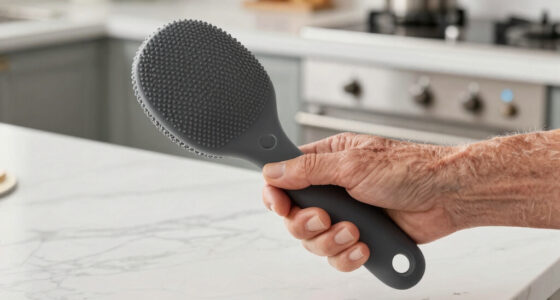
A comfortable cleaning handle lets you hold and guide the tool without squeezing as hard as you can. Its size and shape should suit your hand and the job, and it should stay steady when damp rather than asking your fingers to do all the work. That simple fit can matter more than a long list of features.
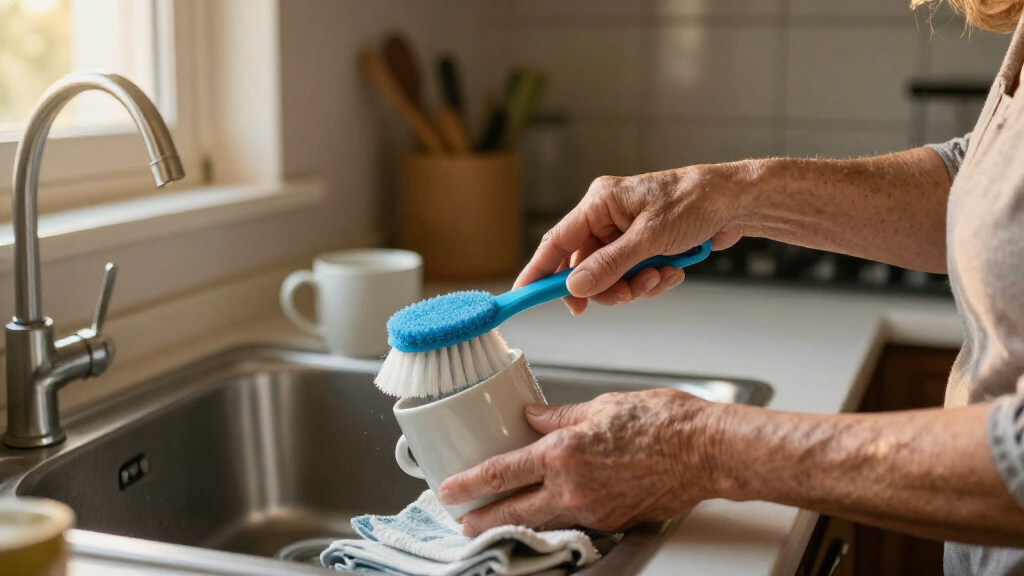
A narrow handle, such as the one on a small detail brush, may feel pinchy if you need to grip it for several minutes. A thicker handle or a purpose-made foam or rubber sleeve can spread pressure over a broader area. For example, if you scrub a sink after breakfast, try holding the brush as you would during the task—not just picking it up for a second. Notice whether your fingers feel cramped and whether the handle turns when you make a short scrubbing motion.
Thicker is not automatically better. If a handle becomes so large that your fingers cannot curl around it comfortably, you may lose control. Rounded and contoured shapes can feel natural to some hands, while a simpler straight shape may suit someone who changes grip often. This is one of the key points for choosing a handle: comfort and control matter more than labels.
When you try a tool, ask yourself three practical questions: Can you hold it without a hard squeeze? Can you guide it along the surface? Can you keep hold of it with slightly wet hands? A tool that passes those checks on a quiet afternoon is more likely to be useful during an ordinary kitchen clean-up, when the counter is damp and the dishwater is still warm.
Products Worth Considering

Greenworks 40V 12-Inch Cordless Chainsaw with 2.0Ah Battery and Charger

Husqvarna 330LK Gas String Trimmer

Traeger Woodridge Pro Wood Pellet Grill and Smoker, 970 sq. in., WiFIRE
As an affiliate, we earn on qualifying purchases.
Compare grip sleeves, gloves, and built-in soft handles
Grip sleeves, well-fitting non-slip gloves, and built-in soft handles can all make a tool feel more secure, but they solve slightly different problems. A sleeve changes the handle itself, gloves add a layer between your hand and the tool, and a soft handle comes as part of the cleaning tool. The right choice depends on what slips, pinches, or feels difficult during your actual chore.
| Option | May help when | Check before relying on it |
|---|---|---|
| Purpose-made grip sleeve | A thin handle feels uncomfortable or hard to hold | It fits securely, stays in place, and can be cleaned |
| Non-slip gloves | Your hand slips on a tool or cleaning bottle | The fit allows finger movement and steady control |
| Built-in soft or textured handle | You want grip features without adapting a separate tool | The texture is comfortable and easy to rinse and dry |
Imagine wiping crumbs from the kitchen table with a narrow-handled brush. A sleeve may make that familiar tool easier to hold without replacing it. But a loose sleeve that rotates during use can create a new problem, so check its fit before you put the tool to work. Improvised padding can also slip, hold grime, or block a switch.
Gloves can help with grip on some bottles and handles, but a glove that is too loose may bunch at the fingertips. A tight glove may make it harder to move your fingers. Try the glove while holding the bottle or brush you use most; the useful test is whether you can pick it up, turn it, and set it down steadily.
Textured rubber and silicone are common handle materials, especially where a wet grip matters. Their performance depends on the texture, the fit of your hand, and whether the surface stays clean and intact. Rinse off residue, follow the maker’s care instructions, and let grips dry fully so they do not become a home for sticky soap film.
Use a step-by-step test to find tools that suit your hand
The simplest way to choose a grip-friendly tool is to test it with the task that gives you trouble. A quick lift tells you about weight, but a short trial tells you much more about balance, reach, and control. If possible, try the tool with dry hands and then with slightly damp hands, since a handle can feel different once water enters the picture.
- Name the hard part. Is it holding a thin brush, twisting a mop, reaching a high shelf, or lifting a full dustpan? Write down one job rather than shopping for a general solution.
- Use the tool as you normally would. Make a few realistic strokes, wipe a small patch of counter, or guide the duster along a shelf. Notice whether you tense your hand or shoulder.
- Check the grip and balance. See whether the handle turns, slips, or feels heavier at one end. A lightweight tool can still feel awkward if its head pulls away from your hand.
- Try the adjustment that matches the problem. Compare a thicker handle, a secure sleeve, a shorter reach, or an easier-wring mop. Change one feature at a time.
- Check care and controls. Make sure the grip can be cleaned and dried, and that buttons or length adjustments are easy for you to operate.
For instance, if you struggle to clean a bathtub edge, try a long-handled scrubber on a small section before tackling the whole tub. If it saves bending but feels top-heavy, a shorter or lighter model may be easier to guide. The point is not to pass a formal test; it is to notice what makes the job feel steadier.
Comfort can also change with the task. A brush that works beautifully on a broad counter may be too large for the narrow rim around a tap. Keeping a small brush for tight corners and a longer-handled tool for wider surfaces can be more useful than asking one multipurpose tool to do everything.
Match handle length and weight to the job
Long-handled dusters, scrubbers, and mops can cut down on bending and reaching, while shorter tools often offer better control in close spaces. The useful choice is the one you can guide comfortably from start to finish. Length helps only when the tool’s weight and balance remain manageable for you.
Picture dusting the top of a bookcase with a long duster. The extra reach can spare you from stretching on tiptoe, but a heavy head may tug at your wrist as you move it side to side. An adjustable handle gives you options: shorten it for the lower shelves, then extend it for the upper trim. Still, the adjustment should be simple enough to manage without wrestling with a stiff lock.
Weight deserves a full-task test, not just a quick lift. A mop that feels light while empty may feel quite different once its head holds water. Likewise, a dustpan can be light overall but awkward if its handle sits at a strange angle. Try guiding the tool across a surface or carrying it from one room to another before deciding it suits you.
One useful rule is to match the tool to the size and position of the work. A small palm-friendly brush gives you control around a tap or stove knob; a longer scrubber can help with the bathtub or shower wall. Reach and balance work as a pair: if extra length makes the tool harder to steer, a different length or lighter head may be a better fit.
Take breaks when a job starts to feel tiring, and divide a large chore into smaller patches. You might dust one room before lunch and the hallway later, rather than carrying a long tool through the whole house in one go. That keeps the work more comfortable without turning a simple cleaning day into a test of endurance.
Reduce squeezing and twisting with easier-action tools
Tools that use leverage or an easy-action mechanism can reduce how much force you need to apply with your hand. Examples include self-wringing mops, long-handled scrubbers, and dustpans with handles that are comfortable to grasp. They do not remove every effort from a chore, but they can replace repeated squeezing or twisting with a simpler movement.
Wringing a mop by hand often asks you to grip, twist, and repeat. A mop with a built-in wringing mechanism may let you press a lever or move a collar instead. That can feel more manageable during a kitchen floor clean, especially if you would otherwise have to wring the mop several times. Check that the mechanism itself moves easily and that you can control the mop when it is wet and heavier.
A long-handled scrubber can use the length of the handle to give you leverage while you clean a shower wall. Instead of pressing down hard with a small brush, you guide the broader tool across the surface. The tradeoff is that a long handle may be less precise around a small fitting, so keep a compact brush for corners and edges.
Cleaning-product packaging can be another grip challenge. A bottle opener or jar-grip aid may help you open a stubborn cap, but make sure you can still dispense the product safely and read its label. For spray bottles, test the trigger with a few slow pulls; some controls require more force than others. Large, simple controls may be easier to use than small or stiff ones, but the best option is the one you can operate steadily.
If pain, weakness, or loss of grip is significant, a qualified occupational therapist can suggest adaptations suited to your needs. That guidance can be especially useful when one adjustment helps a task but makes another harder. You deserve tools that support your independence, not a setup that asks you to push through discomfort.
Adapt tools you already own without creating a slipping hazard
You can often make an existing cleaning tool easier to hold with a purpose-made grip sleeve, provided it fits securely and stays cleanable. This can be a simpler step than replacing a whole set of brushes. The sleeve should not rotate, slide off, or make the tool so bulky that you lose control.
Say the handle on your favorite dustpan feels too thin, but the dustpan itself is light and the edge still lies flat on the floor. A compatible foam or rubber grip sleeve may improve the feel while keeping the familiar tool in service. Before sweeping, hold the dustpan as you normally do and move it gently from side to side; if the sleeve shifts, do not use it until you find a safer fit.
Keep modified handles clean. Textured surfaces can collect dust, soap, and crumbs, especially around the edge of a sleeve. Follow the care instructions for the tool and the grip material; when those instructions allow, wipe away residue with a mild cleaner, rinse as appropriate, and let everything dry fully before storing it.
Avoid loose cloth, tape, or padding that can bunch up or become slick when wet. Also avoid covering a button, release, or adjustment control. A grip modification should make the tool easier to guide, not hide a control or add a part that comes loose halfway through cleaning.
Check the adapted tool every so often, particularly if the sleeve has softened, cracked, or begun to move. A snug, cleanable fit is more useful than padding that feels comfortable for one minute but shifts during a longer task. If you cannot find a secure fit, it may be safer to choose a tool with a handle that already suits your hand.
Build a small, comfortable cleaning kit around your routine
A useful cleaning kit does not need to contain one tool for every imaginable job. Start with a few tools that match the chores you do most: perhaps a palm-friendly brush for the sink, a light duster for shelves, and a mop with a wringing method you can manage. Simple tools that work well for your routine can make cleaning easier without crowding a cupboard.
Imagine your usual Saturday morning: crumbs on the counter, dust along the windowsill, and a splash of water on the kitchen floor. A small brush with a comfortable handle can take care of the counter edges, while a lightweight duster reaches the sill without a big stretch. If the floor mop is difficult to wring, that is a separate problem worth solving rather than buying a whole collection of unfamiliar tools.
Try to match each tool to the space where you use it. A long-handled scrubber may be useful in the bathroom but awkward to store beside a small kitchen sink. A compact tool with a secure grip can be easier to reach for when a spill happens. Replaceable heads and straightforward adjustments can also help, as long as you can change them without struggling with tight fittings.
Before buying, consider the full routine, not only the handle in your palm. Can you carry the tool? Can you store it where you can reach it? Can you clean its grip and operate its controls? A tool that sits unused in a closet because it is cumbersome has not made the chore easier.
Needs vary from person to person, and there is no single handle design that suits everyone. Try a tool if possible, ask someone you trust to help compare options, and change one thing at a time. A comfortable grip is a practical kindness to yourself: it can make an ordinary household task feel less like a wrestling match and more like tending a home at your own pace.
Frequently Asked Questions
What makes a cleaning tool easier to grip?
A comfortable handle size, a secure surface, and manageable weight can make a cleaning tool easier to hold and guide. Look for a handle that does not require a tight squeeze and try it with the movement you use for the chore, such as scrubbing or wiping.
Are thicker cleaning-tool handles always better?
No. A thicker handle can feel more comfortable if a narrow one pinches your fingers, but a handle that is too bulky can make it harder to curl your hand around the tool. Let comfort and control guide the choice rather than assuming one size suits everyone.
Can I make an old cleaning brush easier to hold?
A purpose-made foam or rubber grip sleeve may help if it fits the handle securely. Check that it does not rotate or slide, that you can clean it, and that it does not cover a control or make the tool awkward to guide.
Do long-handled cleaning tools reduce effort?
They can reduce bending and reaching, but a long tool may feel harder to control if it is heavy or poorly balanced. Try it on the surface you need to clean and see whether the added reach feels manageable through several strokes.
How should I clean a textured or soft-grip handle?
Follow the manufacturer’s care instructions, since materials differ. In general, rinse away residue when appropriate, use a suitable mild cleaner, and allow the handle to dry fully; avoid harsh products unless the maker says they are safe for that surface.
What if cleaning tools cause pain or feel unsafe to use?
Stop using a tool that feels unstable or causes discomfort, and consider trying a lighter or easier-action option. If pain, weakness, or loss of grip is significant, a qualified occupational therapist can recommend adaptations based on your needs.
Conclusion
Start with the chore that feels hardest on your hands, then try one change: a better-fitting handle, a secure sleeve, a lighter tool, or a mechanism that cuts down on twisting. Test it with the real task, not just in your palm, and keep it only if it feels steady and manageable.
The best cleaning tool is not the one with the fanciest label. It is the one that lets you finish the job at your own pace, with a little less effort and a little more comfort—then rest easy as the clean kitchen catches the afternoon light.